Enterprise FileNet to SharePoint Migration Services
Migrate Complex FileNet Environments With Control, Visibility, and Business Continuity
ECM Addons provides enterprise IBM FileNet to SharePoint migration services for organizations moving large volumes of documents, metadata, and associated content from complex FileNet environments to SharePoint Online. Our structured approach combines discovery, migration planning, automated content transfer, validation, and controlled cutover to help maintain data integrity, address security requirements, and Zero operational disruption.
Enterprise FileNet Migration Built Around Your Business Requirements
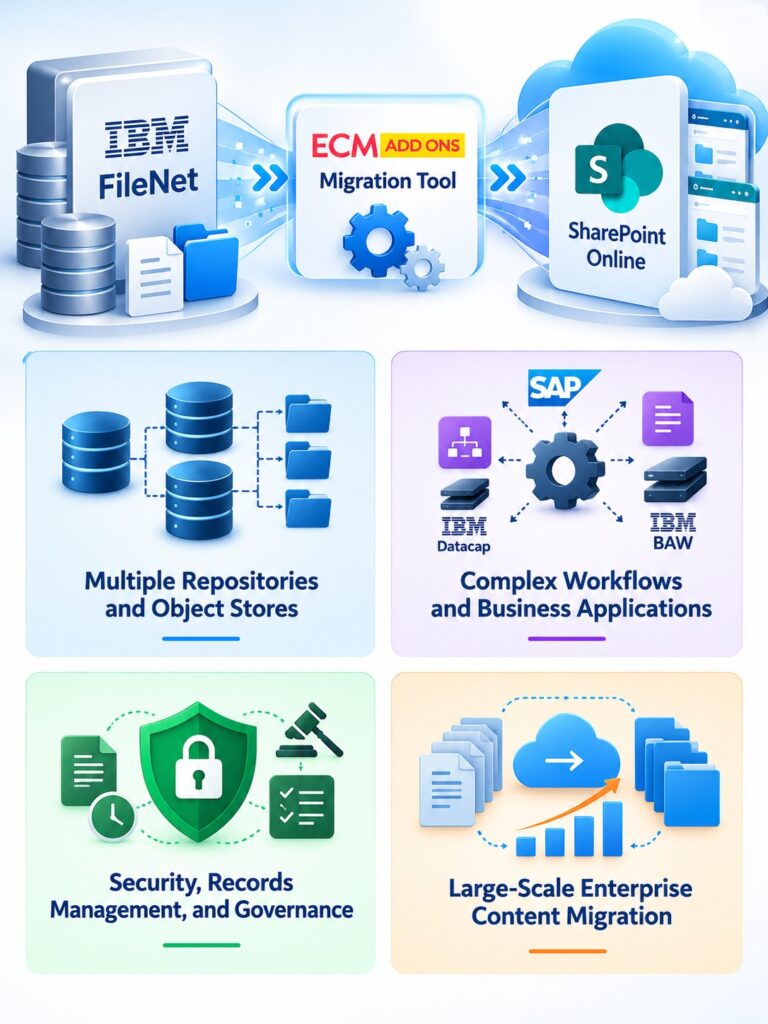
ECM Addons provides enterprise IBM FileNet migration services tailored to complex content structures, application dependencies, security requirements, and business operations. Our approach combines discovery, migration planning, automated content transfer, validation, and controlled cutover to SharePoint Online.
Multiple Repositories and Object Stores
Enterprise FileNet environments may span multiple object stores, document classes, metadata structures, folder hierarchies, and content storage areas. ECM Addons assesses these structures and defines migration mappings to organize content in SharePoint Online while addressing metadata, document relationships, and target information architecture requirements.
Complex Workflows and Business Applications
FileNet content is often closely connected to business workflows, SAP, IBM Datacap, IBM Business Automation Workflow (BAW), custom applications, and enterprise integrations. ECM Addons identifies these dependencies and helps define a transition strategy for each in-scope application, including required integration changes, workflow redesign, and content access updates.
Security, Records Management, and Governance
Enterprise migrations must account for source permissions, records retention requirements, legal holds, audit needs, and governance policies. ECM Addons assesses these requirements and defines target SharePoint Online permissions and governance controls, with validation against agreed migration and compliance requirements.
Large-Scale Enterprise Content Migration
Migrating millions of documents across complex FileNet environments requires structured planning, repeatable migration processes, exception handling, and measurable validation. ECM Addons supports phased migration, progress monitoring, reconciliation, and controlled cutover to help teams manage large content volumes while minimizing operational disruption.
FileNet Migration for Banking and Financial Services
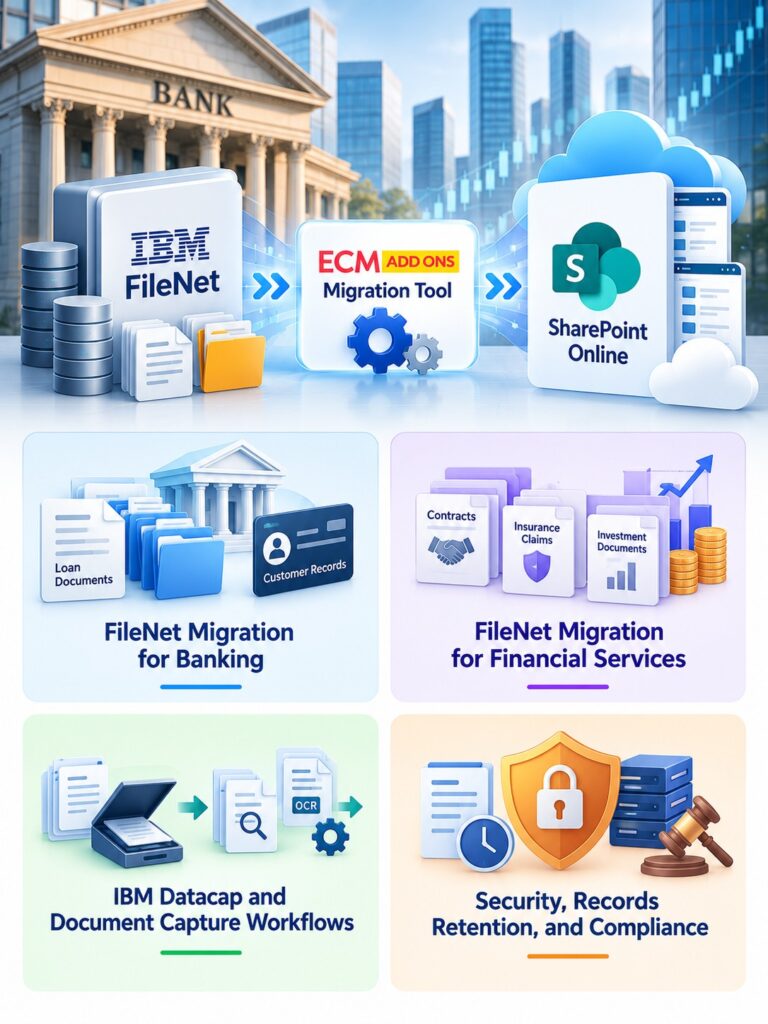
Banking and financial services organizations use IBM FileNet to manage customer records, loan and mortgage documents, financial agreements, insurance claims, transaction records, and compliance documentation. Migrating this content to SharePoint Online requires careful planning for data integrity, security, records retention, application dependencies, and business continuity.
ECM Addons provides FileNet migration services to assess content environments, map documents and metadata, define validation criteria, and plan controlled migration and cutover.
FileNet Migration for Banking
Assess customer and loan records, mortgage documents, document relationships, access permissions, and dependent applications. Define migration priorities, target mappings, and validation requirements for a controlled transition to SharePoint Online.
FileNet Migration for Financial Services
Plan the migration of contracts, investment documents, insurance claims, financial records, and other business-critical content. Organize migration waves around content dependencies and operational priorities, with reconciliation, exception tracking, and validation before cutover.
IBM Datacap and Document Capture Workflows
Banking environments may use IBM Datacap and FileNet document acquisition capabilities to capture, classify, extract data from, and route documents into business processes. We assess dependencies involving document capture, classification, metadata extraction, ingestion workflows, and downstream FileNet repositories to determine how these capabilities and related processes should be supported in the target environment.
Security, Records Retention, and Compliance
Assess access controls, retention schedules, records-management policies, audit requirements, and applicable regulatory obligations. Define and validate the controls required in the target environment throughout migration.
FileNet Migration for Government Organizations
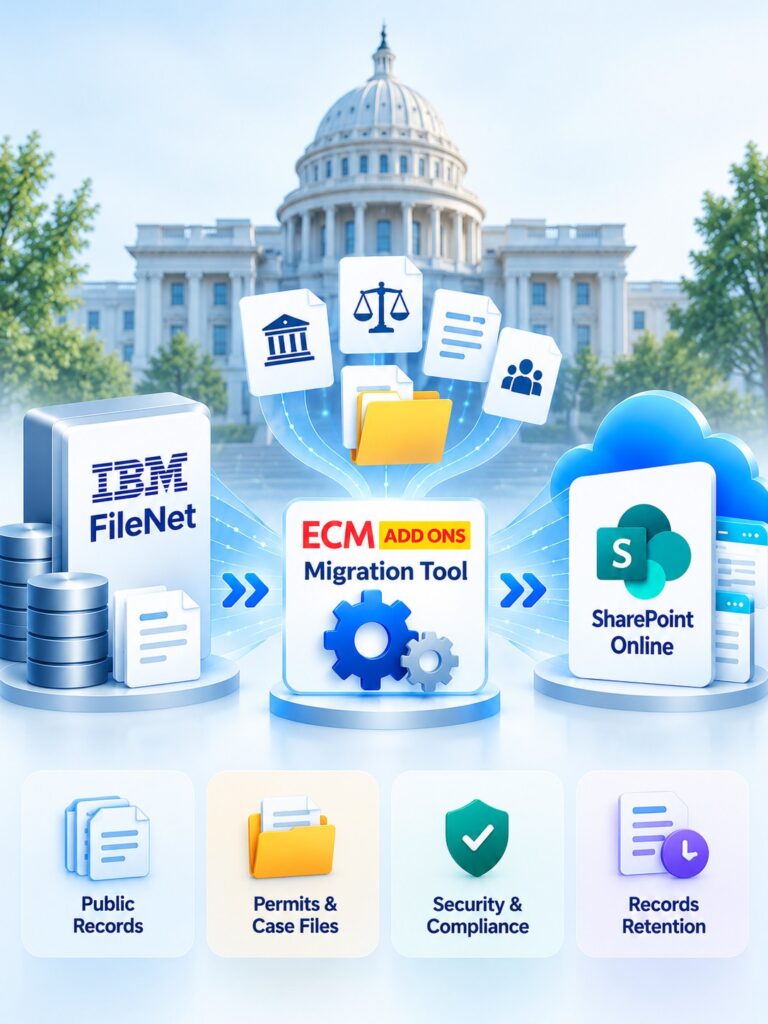
Government organizations use IBM FileNet to manage public records, legal documents, permits, case files, policy documents, and other mission-critical information. Migrating this content to SharePoint Online requires careful planning for records retention, access controls, audit requirements, document relationships, and agency-specific business processes.
ECM Addons provides FileNet migration services to assess complex government content environments, map documents and metadata, evaluate application dependencies, and establish validation criteria for a controlled migration and cutover to SharePoint Online.
FileNet Migration for Federal, State, and Local Government Agencies
Assess FileNet repositories, document classes, departmental content ownership, and application dependencies. Plan migration waves around agency priorities and target-environment readiness for a structured transition to SharePoint Online.
IBM Datacap, BAW, and Document-Driven Workflows
Assess dependencies involving IBM Datacap document capture and processing, IBM Business Automation Workflow (BAW), case management, and FileNet-connected business processes. Identify how document acquisition, workflow activities, metadata, and application integrations should be supported after migration.
Records Retention and Public Records Management
Assess retention schedules, archival requirements, legal holds, public-records obligations, and associated metadata. Define and validate how records, access requirements, and retention controls will be supported in the target environment.
Secure Migration and Controlled Cutover
Validate migrated content, access controls, and application dependencies. Track exceptions, reconcile migration results, and establish cutover approvals and recovery procedures to support continuity of government services.
FileNet Migration for Oil, Gas, and Energy Organizations
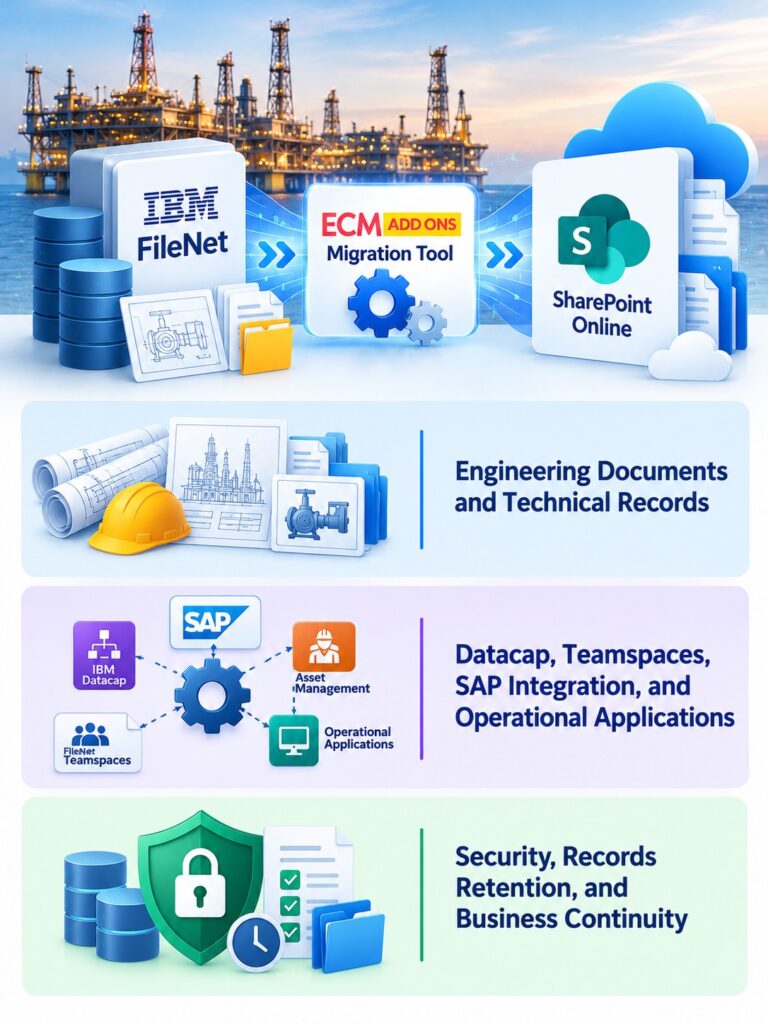
Oil, gas, and energy organizations use IBM FileNet to manage engineering documents, technical drawings, asset records, maintenance documentation, project files, and operational records. Migrating this content to SharePoint Online requires planning for metadata, security, records retention, and business-critical application integrations.
ECM Addons provides FileNet migration services to assess complex environments, define migration scope, map content and metadata, and plan validation and controlled cutover.
Engineering Documents and Technical Records
Assess engineering drawings, equipment specifications, technical manuals, project files, and asset records across FileNet repositories and object stores. Map content and metadata, preserve document relationships, and validate migrated information in SharePoint Online.
Datacap, Teamspaces, SAP Integration, and Operational Applications
Assess IBM Datacap document capture and acquisition workflows, FileNet Teamspaces, SAP integrations, asset management systems, maintenance applications, and project workflows. Identify dependencies involving document ingestion, metadata, content access, and business processes to determine how these capabilities should be supported after migration.
Security, Records Retention, and Business Continuity
Evaluate access permissions, records-retention requirements, and operational dependencies. Plan phased migration, content reconciliation, exception management, and controlled cutover to support data integrity and minimize disruption to business operations.
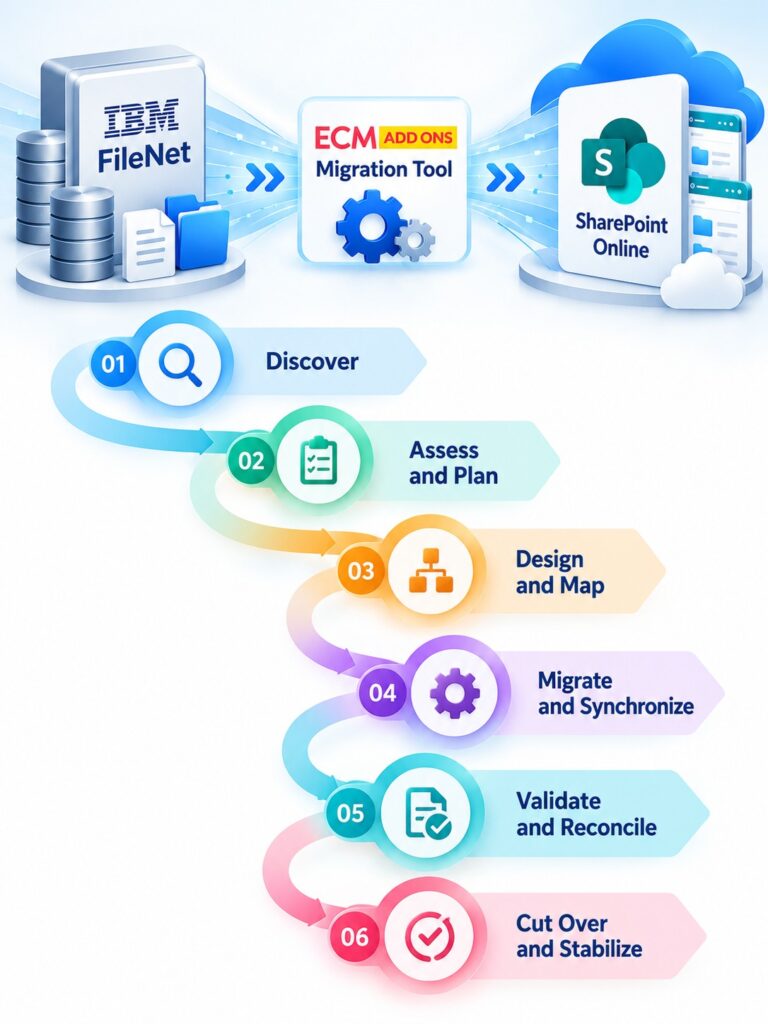
A Structured Approach to Enterprise FileNet to SharePoint Migration
Every enterprise FileNet environment has its own repository structure, content dependencies, and business requirements. Our migration approach is designed to establish those requirements before execution and maintain visibility through validation and cutover.
Discover
Analyze repositories, object stores, document classes, metadata, security, workflows, applications, integrations, and content volumes to establish the migration scope.
Assess and Plan
Evaluate complexity, dependencies, business priorities, transformation needs, and potential exceptions. Define migration waves and acceptance criteria around the actual environment.
Design and Map
Define the target architecture and map FileNet content structures, metadata, security requirements, and relevant business relationships. Identify where transformation, redesign, or alternative capabilities are needed.
Migrate and Synchronize
Automate content movement in controlled waves. Where required, keep the source environment operational and synchronize relevant changes while migration progresses.
Validate and Reconcile
Compare migration results against agreed criteria, including content completeness, integrity, required attributes, security, relationships, and application readiness.
Cut Over and Stabilize
Transition approved workloads once the required validation and readiness criteria have been met. Monitor the target environment and address outstanding issues during the agreed stabilization period.
ECM Addons Enterprise IBM FileNet Migration Capabilities
Build a consolidated view of repositories, object stores, content structures, and dependencies to support scope definition and migration planning.
Organize migration activity around business priorities, repository boundaries, application dependencies, and target readiness.
Define mapping and transformation rules for document classes, properties, classifications, relationships, and target information architecture.
Automate repeatable migration activities and support consistent execution across large content sets and multiple migration waves.
Where supported by the source environment and migration solution, synchronize relevant content changes during the migration period to prepare for controlled cutover.
Track processing progress, failures, pending items, and exceptions so teams can identify issues and prioritize remediation.
Compare migration results with defined expectations and document discrepancies, exclusions, remediation, and readiness for business transition.
Migration Visibility Beyond Document Counts
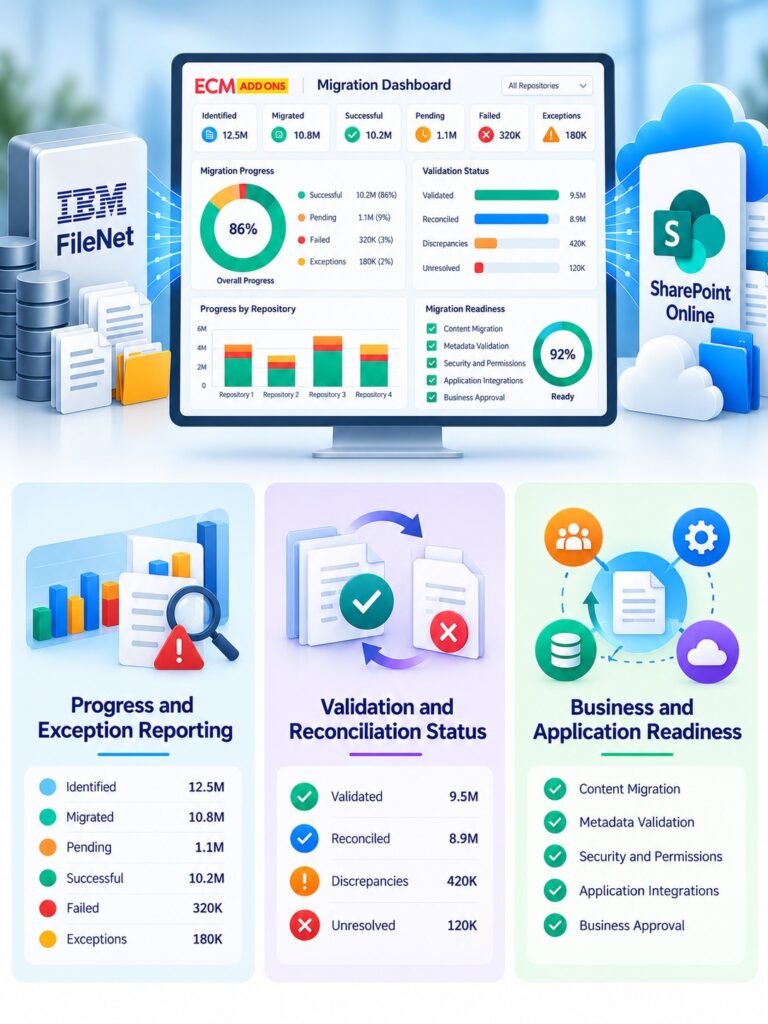
At enterprise scale, a single completion percentage cannot show whether content is ready for business use. Migration teams need visibility into what has been identified, transferred, validated, reconciled, and left unresolved.
ECM Addons can support centralized migration reporting across identified, migrated, pending, successful, failed, exception, validation, reconciliation, and readiness states. This helps technical teams and business stakeholders understand progress, assess outstanding risks, and make informed decisions about migration-wave completion.
Progress and Exception Reporting
Track identified, migrated, pending, successful, failed, and exception items across repositories and migration waves. Provide visibility into processing status and outstanding issues so teams can prioritize remediation and monitor migration progress.
Validation and Reconciliation Status
Compare migration results against agreed source-to-target criteria, including content completeness, file integrity, required metadata, and other in-scope attributes. Track discrepancies, exclusions, remediation, and unresolved exceptions before migration acceptance.
Business and Application Readiness
Assess whether the content, integrations, and business dependencies included in a migration wave have met the agreed transition criteria.
Why Choose ECM Addons for Enterprise FileNet Migration?
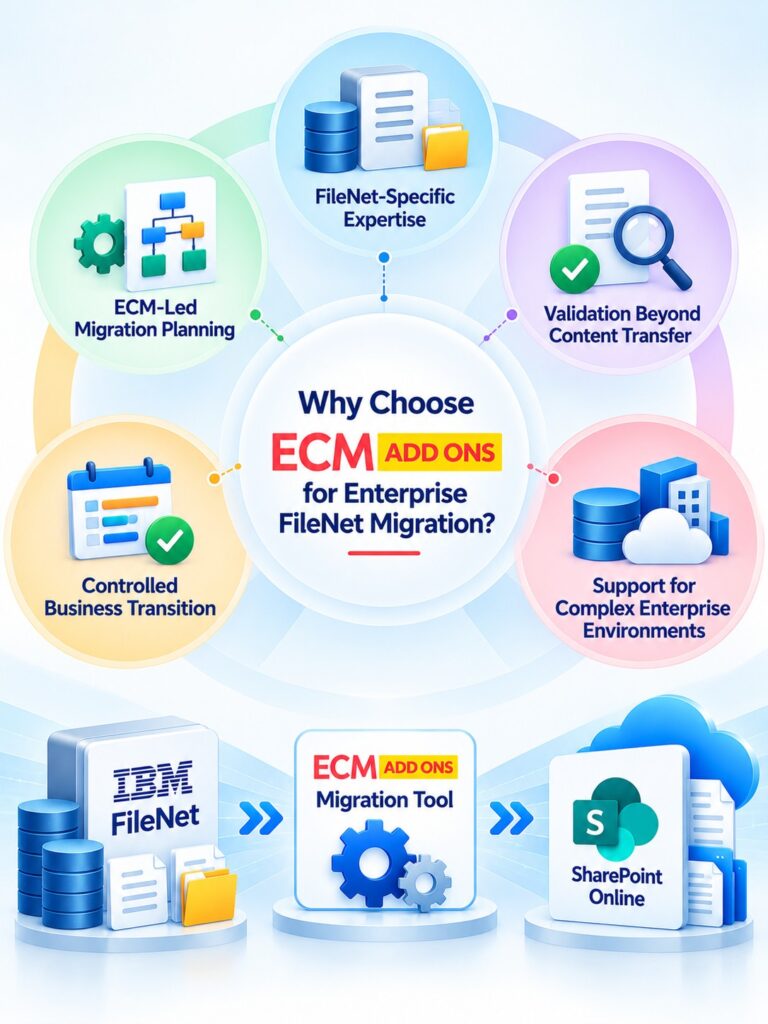
FileNet-Specific Expertise
A migration strategy grounded in understanding FileNet repositories, object stores, document structures, security models, workflows, and application dependencies.
ECM-Led Migration Planning
Define migration rules, content mappings, transformation requirements, target SharePoint architecture, and migration-wave sequencing based on the source environment and target business requirements.
Validation Beyond Content Transfer
A focus on agreed content, metadata, security, relationship, and application validation criteria-not simply the number of documents transferred.
Controlled Business Transition
Phased migration, relevant synchronization, documented acceptance criteria, and cutover planning to support continuity for business functions that depend on FileNet.
Support for Complex Enterprise Environments
An approach suited to large content volumes, distributed repositories, regulated requirements, and interconnected business applications.
Start Your Enterprise FileNet to SharePoint Migration Today
Plan your enterprise IBM FileNet to SharePoint migration with ECM Addons. Assess repositories, metadata, business-critical workflows, integrations, and security requirements to establish a structured migration strategy with automated content transfer, validation, and controlled cutover.
Frequently Asked Questions
Enterprise FileNet Migration Services cover the discovery, assessment, planning, mapping, transformation, migration, synchronization, validation, and cutover activities required to move complex FileNet environments to a target platform.
Yes. Migration planning can address banking and financial services requirements involving large content volumes, document relationships, access controls, records, business applications, and integration dependencies.
Yes. The migration approach can account for government repositories, agency-specific access requirements, applicable records retention, public-records obligations, application dependencies, and controlled cutover.
Yes. Multiple repositories and object stores can be assessed and incorporated into a migration strategy based on content scope, technical dependencies, business priorities, and target readiness.
Workflows, APIs, custom applications, and SAP, ERP, or CRM integrations are identified during discovery. Their target implementation depends on the source configuration, business requirements, and target architecture.
Large migration programs can be organized into controlled waves supported by automation, monitoring, synchronization, exception management, and validation. Pilot results and actual environment constraints should inform throughput estimates and delivery planning.
Validation can cover content counts, file integrity, required metadata, versions, security, relationships, exceptions, reconciliation, and application readiness, according to the agreed scope and acceptance criteria.