FileNet Migration for Regulated Industries
Migrate Regulated Content Without Losing Control
FileNet Migration for Regulated Industries requires more than moving documents from one repository to another. Security, retention, records, auditability, business processes, and access controls must remain accounted for throughout the transition.
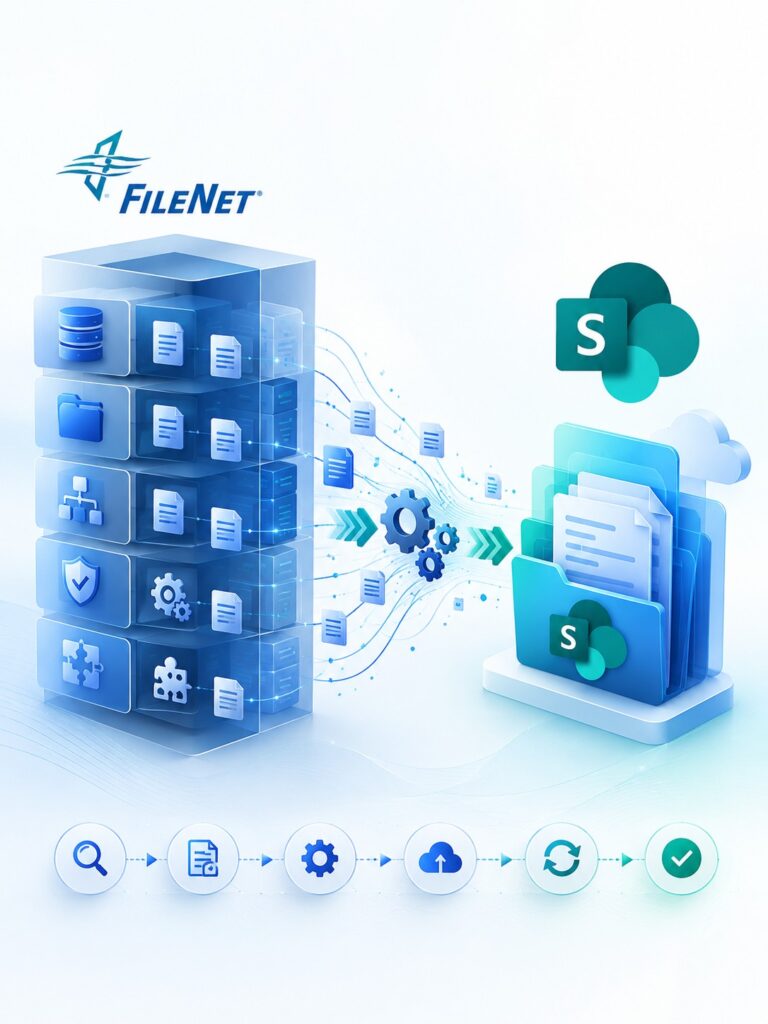
Why Regulated FileNet Migration Requires a Different Approach
In a regulated environment, a successful migration cannot be measured only by whether documents arrive in the destination. Content may be connected to permissions, classifications, retention requirements, records controls, workflows, applications, integrations, and audit-related information.
These relationships determine how information can be accessed, managed, retained, reviewed, and disposed of. A regulated migration therefore needs to protect both content integrity and control integrity, with those requirements defined before migration execution begins.
FileNet Migration Solutions for Regulated Industries
Modernize FileNet repositories containing loan documents, mortgage records, customer files, financial agreements, and compliance-related content while accounting for security, retention, and audit requirements.
Plan migrations involving patient documentation, medical records, insurance claims, authorizations, and healthcare administration content while considering applicable privacy and records requirements.
Address complex FileNet environments supporting claims processing, policy administration, underwriting, and customer correspondence, including dependencies on business applications and workflows.
Modernize document imaging, public records, case files, benefits administration, and agency document repositories while accounting for records management, access restrictions, and applicable government requirements.
Plan migrations involving quality management documents, standard operating procedures, clinical research documentation, validation records, and controlled business content.
Modernize FileNet repositories containing engineering documentation, asset records, operating procedures, maintenance documentation, and safety-related content.
Governance, retention, records, and applicable regulatory requirements can influence migration scope, target architecture, and decisions about what should be migrated, retained, archived, or excluded.
What Must Remain Controlled During FileNet to SharePoint Migration?
01-Content & Information Integrity
Content needs to remain complete, accessible, and associated with the metadata and business context required by the organization. Migration scope and validation criteria should define what must be transferred and how completeness will be established.
02-Security & Access Control
FileNet permissions may reflect business roles, sensitive content, repositories, document classes, or applications. These access requirements need to be assessed and mapped to an appropriate target security model.
03 - Metadata & Classification
Metadata can influence how regulated content is classified, searched, governed, retained, and processed. Relevant properties and classifications should therefore be identified before source-to-target mapping and transformation are defined.
04 -Retention & Records
Some content may be subject to retention periods, records requirements, legal holds, or controlled disposition. These obligations need to be understood before determining how the content will be migrated and governed after transition.
05 - Auditability & Traceability
Regulated organizations may need visibility into what was migrated, what was validated, and which exceptions remain. Migration reporting, reconciliation, validation, and exception management provide that traceability.
06 - Workflows & Business Processes
Documents may participate in approvals, reviews, cases, or other operational processes. These dependencies need to be identified so that migration does not separate regulated content from the processes that rely on it.
07 - Enterprise Integrations
SAP, ERP, CRM, APIs, and other enterprise systems may create, consume, or reference FileNet content. These dependencies can influence migration sequencing, application readiness, validation, and cutover planning.
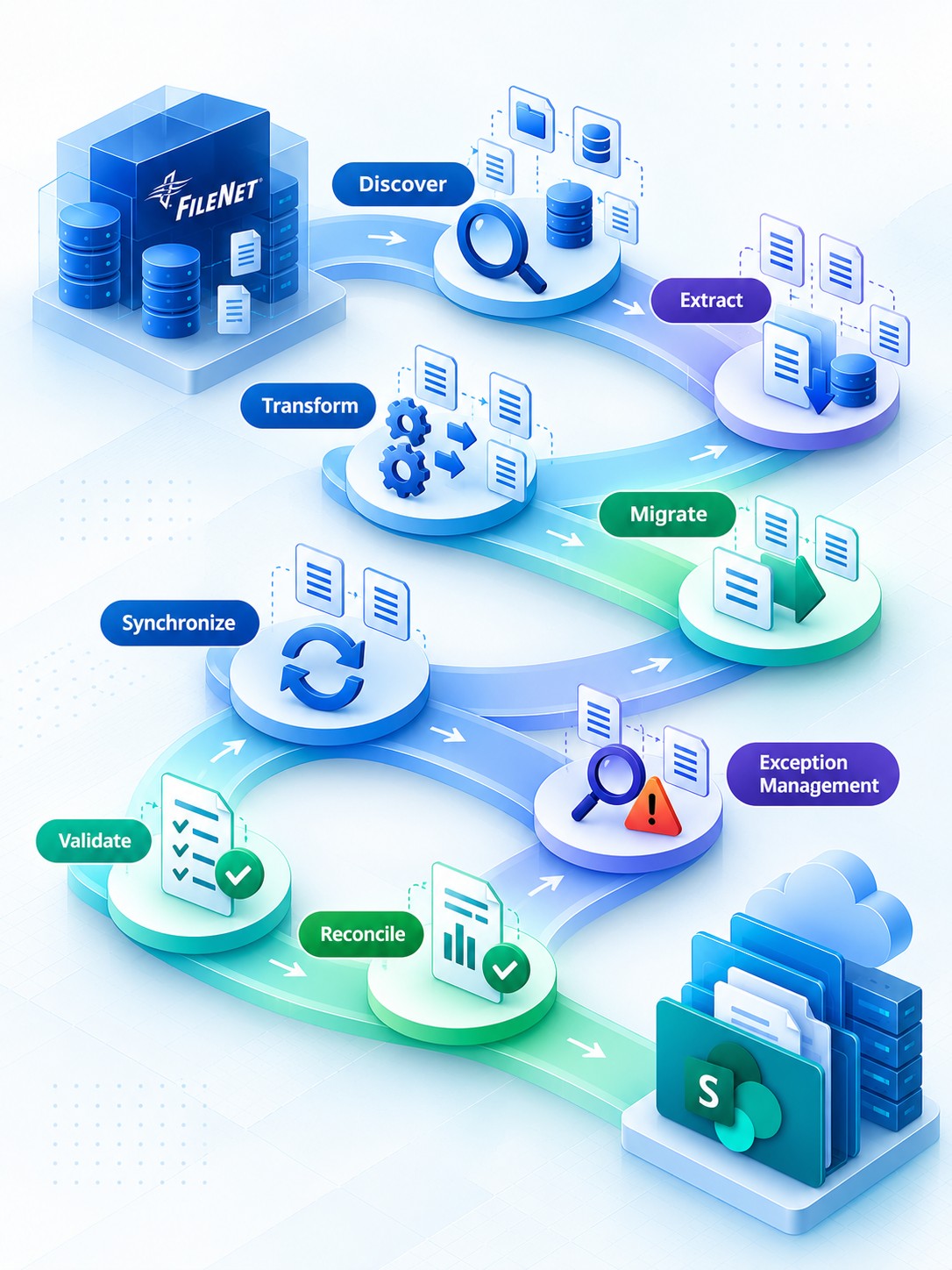
A Compliance-Aware FileNet to SharePoint Migration Approach
Discover the FileNet Environment
The migration begins with an assessment of repositories, content, metadata, classifications, security, workflows, applications, integrations, and governance dependencies. The objective is to establish the actual migration landscape before content movement begins.
Assess Scope and Requirements
The environment is evaluated against business, security, governance, retention, records, and operational requirements. This helps determine what needs to be migrated, transformed, retained, archived, or addressed separately.
Define Controls and Target Requirements
The migration model establishes how content, metadata, permissions, governance requirements, and relevant dependencies should operate in the target. For SharePoint or Microsoft 365, the target design can incorporate the required information architecture, permissions, and governance model.
Map and Transform
Source structures and controls are mapped to the target architecture. Where direct mapping is not appropriate, content, metadata, classifications, or security requirements can be transformed according to the agreed migration model.
Migrate and Synchronize
Migration can be executed through controlled waves using automation and migration tooling. Where FileNet must remain operational during the transition, synchronization or delta migration can be incorporated before final cutover.
Validate and Reconcile
Migration results are validated against agreed criteria covering content, metadata, security, structures, and other applicable requirements. Reconciliation and exception reporting identify discrepancies that need attention before acceptance.
Cut Over and Stabilize
Final synchronization, validation, application readiness, and business requirements are coordinated before transition. The objective is a controlled move into the target without leaving compliance and governance activities until after migration.
ECM Addons FileNet Migration Capabilities for Regulated Environments
Compliance-Focused Environment Discovery
Identify repositories, content, metadata, security structures, workflows, integrations, and governance dependencies before defining migration scope.
Security & Permission Mapping
Assess source access requirements and establish how appropriate security controls should be represented in the target environment.
Metadata & Classification Mapping
Preserve relevant classification and business information while adapting legacy structures to the target information architecture.
Retention & Records Considerations
Identify content subject to retention, records, legal hold, or disposition requirements and incorporate those requirements into migration planning.
Audit-Oriented Reporting
Maintain visibility into migration progress, validation results, reconciliation, and exceptions for project and governance stakeholders.
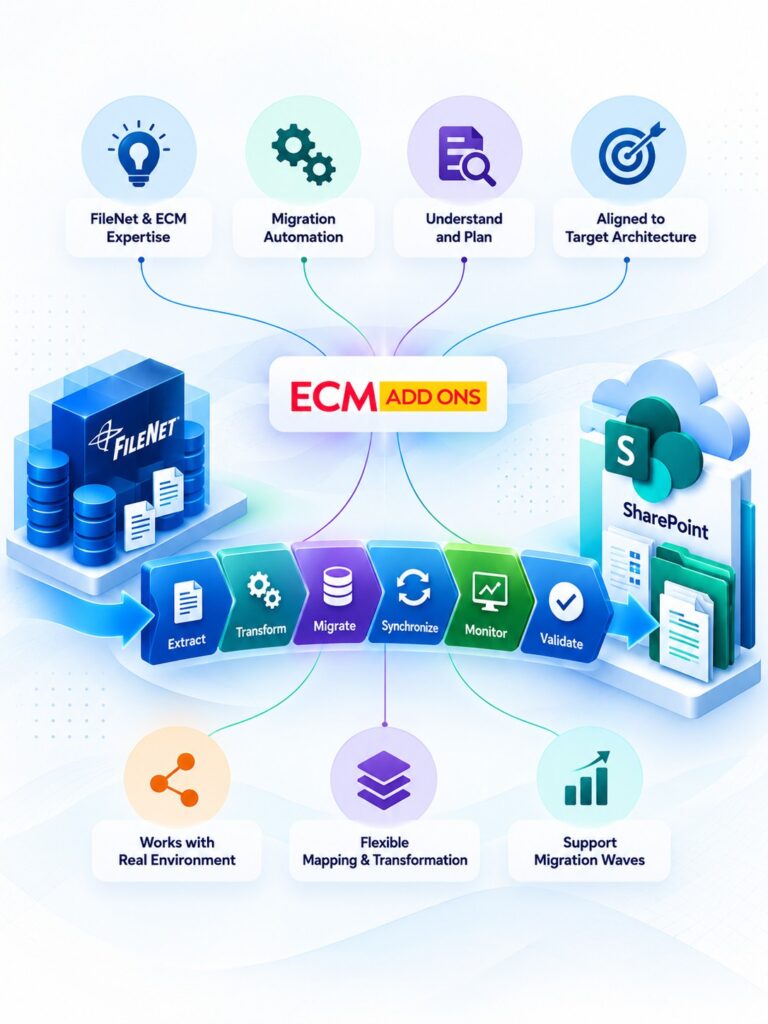
Modernize your ECM Without Compromising Governance
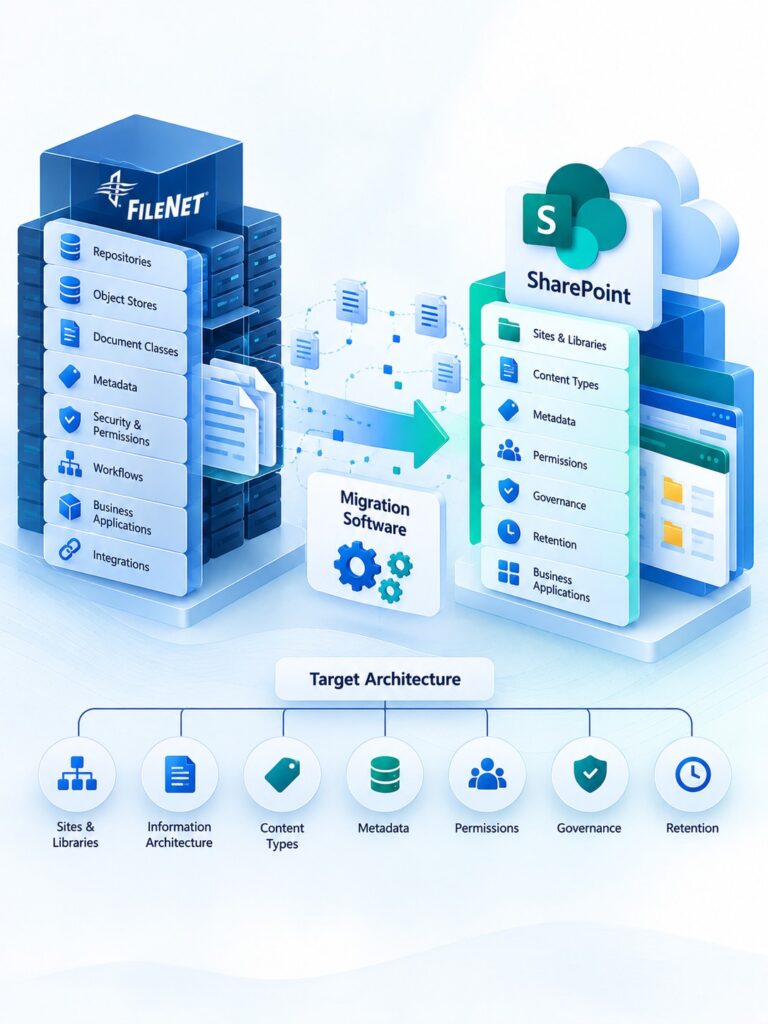
A regulated organization moving from FileNet to SharePoint Online does not necessarily need to reproduce every legacy structure. The target can be designed around current information, security, governance, retention, collaboration, and integration requirements.
The important distinction is to preserve the information and controls the business requires, rather than automatically preserving every technical structure that existed in FileNet. This allows modernization to improve the target environment without treating governance as something separate from migration.
Microsoft’s current SharePoint guidance similarly treats information architecture as a combination of navigation, site structure, metadata, search, and security, reinforcing the need to design the target rather than simply reproduce the source.
Built for Complex Enterprise FileNet Environments
Sensitive & Controlled Content
Different content categories may carry different security, retention, and governance requirements. Migration planning can account for those differences instead of applying one rule to every content group.
Complex Security Models
Enterprise FileNet environments can contain different access requirements across repositories, document classes, business units, and applications. These relationships need to be understood before defining the target security model.
Records & Retention Requirements
Content governed by retention or records policies requires additional consideration. The migration strategy should establish how those requirements will continue to be addressed after transition.
Audit & Evidence Requirements
Migration activities need sufficient visibility to demonstrate what was migrated, how results were validated, and which exceptions remain. Validation, reconciliation, and reporting support evidence.
Business-Critical Applications
When regulated content is connected to applications, workflows, SAP, or other enterprise systems, those dependencies can influence migration sequencing, application readiness, and cutover decisions.
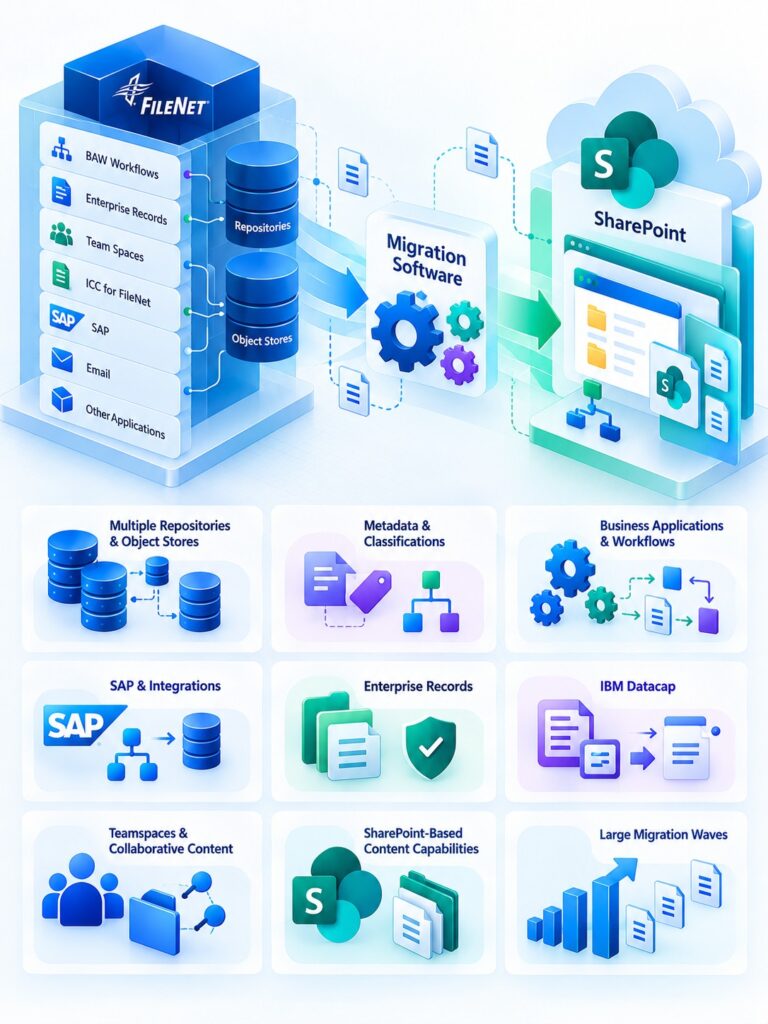
FileNet Expertise With Governance Built Into the Migration
ECM Addons begins by understanding the FileNet environment and the controls surrounding its content before defining the migration model.
Permissions and access requirements are considered alongside content and metadata rather than treated as a separate activity after migration.
Regulated migration acceptance can require validation of content, metadata, classifications, security, structures, relationships, and identified exceptions-not simply confirmation that documents exist in the destination.
Where business operations must continue during migration, phased execution, synchronization, testing, validation, and controlled cutover can be incorporated into the migration strategy.
What a Controlled Regulated-Industry Migration Enables
A compliance-aware FileNet migration creates a clearer path from a legacy content environment to a modern target architecture while keeping security, governance, and business requirements visible throughout the project.
It can help organizations improve migration visibility, preserve relevant business and compliance context, maintain control over access requirements, incorporate retention and records considerations, establish traceable validation, reduce repetitive migration effort through automation, and support a controlled transition.
Request Your Regulated FileNet Migration Assessment
Plan a controlled FileNet migration for your regulated environment. Assess your content, security, retention, governance, and business dependencies, and define a migration approach designed to maintain control throughout the transition.
Frequently Asked Questions
Regulated environments may have additional requirements around security, access, retention, records, governance, auditability, and business continuity. These requirements need to be considered as part of migration planning rather than addressed only after content reaches the target.
Security requirements can be assessed and mapped during migration planning. The appropriate target implementation depends on the destination platform, source security model, and specific business requirements.
Retention and records requirements are identified during discovery and assessment. The migration strategy then determines how applicable content and governance requirements should be represented or maintained in the target environment.
This depends on the specific audit information, source configuration, target requirements, and migration scope. Relevant audit and traceability requirements should be identified during discovery so they can be incorporated into migration design and validation.
It can support migrations involving repositories, document classes, metadata, security requirements, and other information that needs to be considered alongside the content itself.
Validation is based on agreed migration criteria and can cover content, metadata, classifications, security, structures, relationships, and identified exceptions. Reconciliation provides additional visibility into differences between source and target.
Depending on the migration architecture and business requirements, FileNet can remain operational during migration. Synchronization or delta migration can be incorporated before final cutover where required.
Yes. Migration waves can be organized around business units, repositories, content groups, applications, or regulatory requirements. Phased execution also provides opportunities to validate results before subsequent waves.
Yes, where the target architecture and business requirements are appropriate. The migration needs to determine how FileNet content, metadata, security, governance, retention, and application dependencies should be represented in the Microsoft target environment.