What Are FileNet Managed Services?
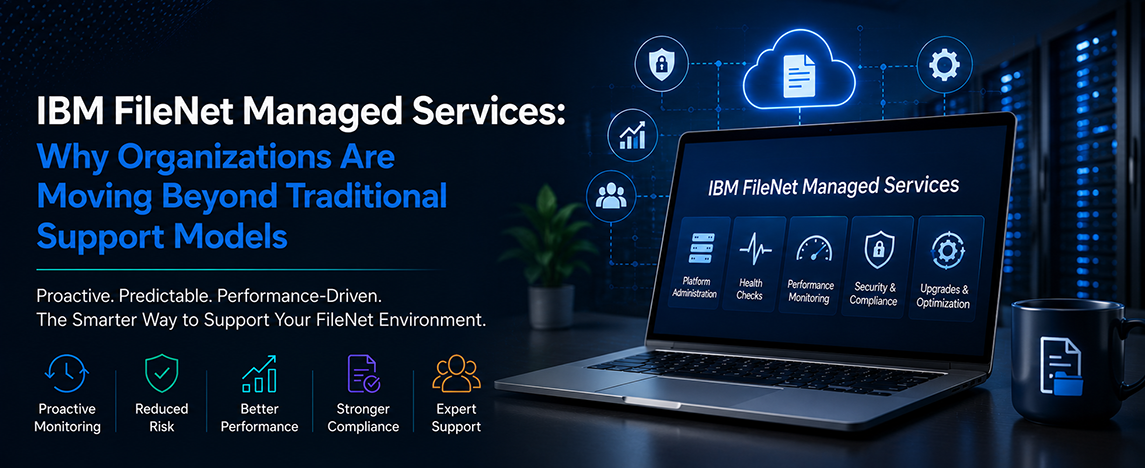
IBM FileNet Managed Services provide ongoing administration, monitoring, support, optimization, governance, and operational management of FileNet environments.
Unlike traditional support models that focus on resolving tickets after problems occur, managed services provide a proactive operating framework designed to improve platform stability, reduce operational risk, and ensure business continuity.
For organizations that rely on FileNet to manage critical business content, the goal is not simply keeping the platform running. The goal is ensuring FileNet remains secure, available, optimized, and aligned with business objectives.
The Growing Challenge of Managing IBM FileNet
Many organizations built their FileNet environments years ago.
The platform continues to support critical business operations, but the environment surrounding it has changed significantly.
Today, organizations face several emerging challenges.
The Aging FileNet Workforce
One of the most overlooked risks in enterprise content management is the shrinking pool of experienced FileNet professionals.
Many organizations depend on a small number of individuals who possess deep knowledge of:
- Content Engine
- Process Engine
- Workflow configurations
- Security models
- Custom integrations
- Database architecture
When these individuals retire, change roles, or leave the organization, critical operational knowledge often leaves with them.
The result can be increased downtime, slower issue resolution, and higher operational risk.
Security and Compliance Pressures Continue to Increase
Organizations must now navigate increasingly complex regulatory requirements.
At the same time, many FileNet environments are running:
- Older versions
- Legacy integrations
- Aging infrastructure
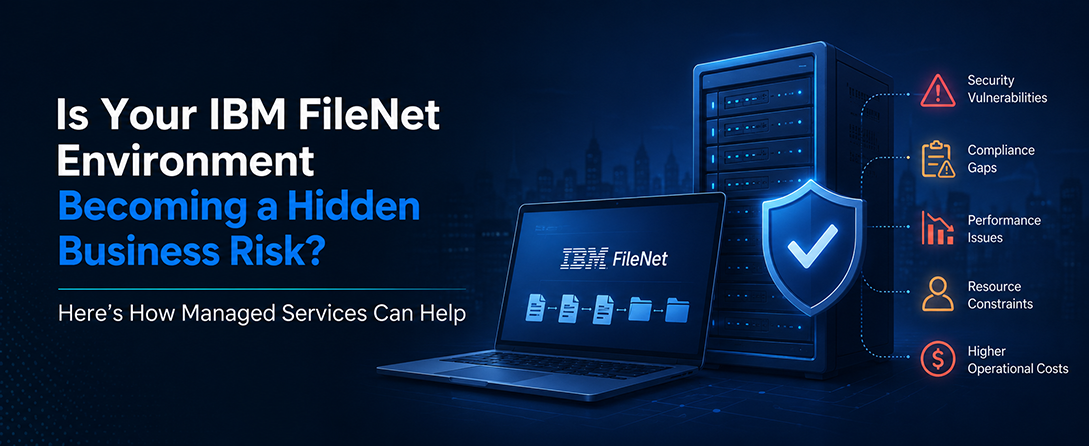
Without proactive governance, organizations can expose themselves to compliance risks, audit findings, and security vulnerabilities.
Operational Complexity Continues to Grow
As repositories expand and business demands increase, organizations often experience:
- Slow document retrieval
- Workflow bottlenecks
- Content Engine performance degradation
- Database growth challenges
- Storage management issues
These problems rarely appear overnight.
They develop gradually until they begin impacting users and business operations.
Why Traditional Support Models Are No Longer Enough
Many organizations still operate under a reactive support model.
A problem occurs.
A ticket is opened.
The issue is resolved.
The cycle repeats.
While this approach may keep the environment operational, it rarely improves platform health.
In many cases, organizations become trapped in a constant cycle of firefighting.
Managed Services introduce a fundamentally different approach.
Rather than focusing solely on issue resolution, the objective becomes platform ownership, operational excellence, and continuous improvement.
The Five Pillars of Effective FileNet Managed Services
1. Monitor
Continuous monitoring provides visibility into:
- Platform availability
- System health
- Storage consumption
- Database performance
- User activity
The goal is to identify issues before users experience them.
2. Manage
Day-to-day administration includes:
- Incident management
- User support
- Configuration management
- Operational maintenance
- Platform administration
This ensures ongoing stability and reliability.
3. Optimize
FileNet environments should continuously evolve.
Optimization activities include:
- Performance tuning
- Capacity planning
- Workflow improvements
- Infrastructure recommendations
- Repository health reviews
Small improvements over time can significantly improve platform performance.
4. Govern
Governance ensures accountability.
Key governance activities include:
- SLA management
- KPI reporting
- Risk management
- Service reviews
- Compliance monitoring
Strong governance transforms support from a technical function into a business capability.
5. Improve
The best managed services programs focus on continuous improvement.
Organizations should expect:
- Knowledge retention
- Operational maturity
- Process refinement
- Strategic recommendations
- Ongoing optimization opportunities
This creates long-term business value rather than short-term issue resolution.
Why Team-Based Delivery Matters
Many organizations unknowingly create operational risk by depending on a single FileNet administrator.
When one person becomes the primary source of platform knowledge, the organization creates a critical dependency.
A mature managed services model eliminates this risk through:
- Cross-trained specialists
- Shared knowledge repositories
- Standardized operating procedures
- Centralized documentation
- Defined escalation paths
The objective is simple:
Zero single-person dependency.
Knowledge belongs to the organization—not individual employees.
Business Outcomes of FileNet Managed Services
The most successful organizations measure managed services by business outcomes rather than technical activities.
Operational Excellence
Proactive monitoring and standardized operations improve platform reliability.
Business Continuity
Cross-trained teams reduce dependency risks and ensure continuity during personnel changes.
Governance and Accountability
Defined SLAs, KPI reporting, and service reviews provide visibility and control.
Strategic Growth Enablement
Internal teams can focus on modernization and transformation initiatives instead of day-to-day platform maintenance.
Frequently Asked Questions
What is the difference between FileNet support and FileNet managed services?
Traditional support typically focuses on resolving issues after they occur. Managed services provide proactive monitoring, administration, optimization, governance, and continuous improvement.
Can managed services reduce operational risk
Yes. Managed services reduce dependency on individual resources, improve knowledge retention, and establish structured operational processes.
Are managed services suitable for older FileNet environments?
Absolutely. Many organizations use managed services to stabilize and optimize legacy FileNet environments while planning future modernization initiatives.
Do managed services help with upgrades and modernization?
Yes. Managed services providers often support upgrade planning, modernization assessments, and long-term FileNet roadmaps.
The Future of FileNet Operations
The question facing most organizations is no longer whether FileNet remains important.
The real question is whether the current operating model can support the platform reliably over the next five years.
As experienced FileNet professionals become harder to find, operational complexity increases, and compliance requirements continue to evolve, organizations need more than technical support.
They need a governed operational framework that ensures stability, accountability, business continuity, and continuous improvement.
Because the goal is not simply managing FileNet.
The goal is ensuring the business systems that depend on FileNet continue to perform when they matter most.
Ready to Strengthen Your FileNet Operations?
If your organization is struggling with aging expertise, rising support demands, or increasing operational risk, now is the time to evaluate a more proactive approach.
A FileNet Managed Services model can help you improve stability, reduce dependency on key individuals, strengthen governance, and create a more resilient operating environment.
Contact us today to discuss your FileNet environment and explore how managed services can support your long-term business goals.