Most Organizations Underestimate the True Cost of FileNet Operations
When organizations evaluate the cost of running IBM FileNet, they typically focus on visible expenses:
- Software licensing
- Infrastructure
- Storage
- Databases
- Internal support resources
These costs are easy to measure because they appear directly on budgets and invoices.
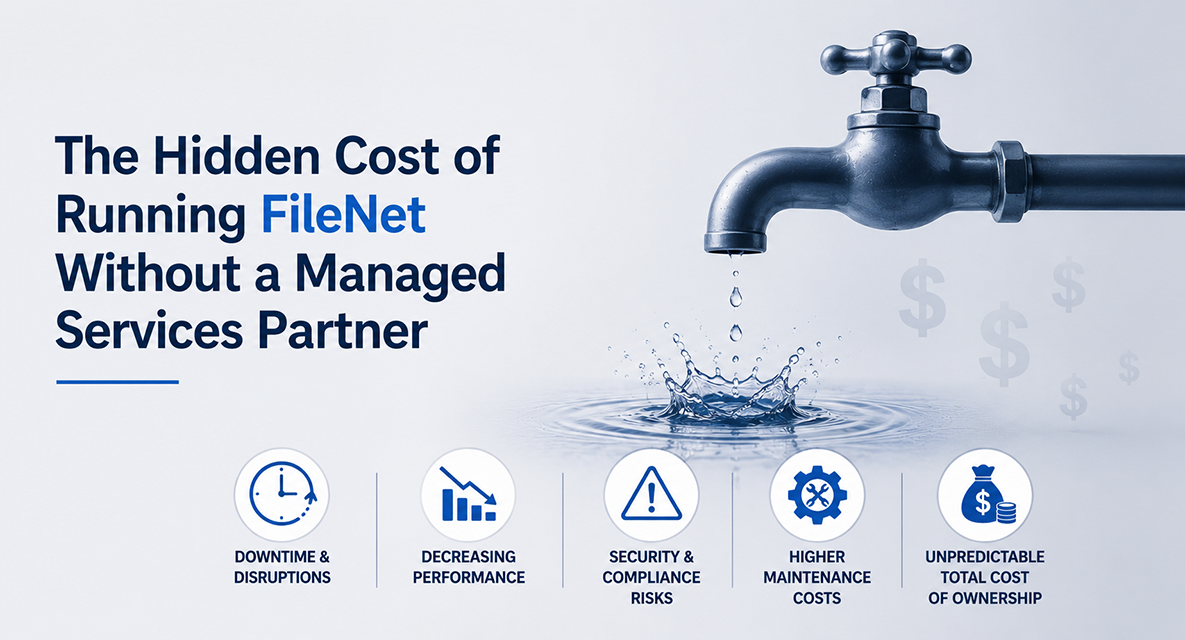
However, the largest FileNet expenses are often hidden.
They emerge through operational inefficiencies, downtime, knowledge gaps, delayed projects, compliance risks, and reactive support models that gradually consume time and resources.
The result is that many organizations spend far more maintaining FileNet than they realize.
The Problem Isn't the Platform
IBM FileNet continues to be one of the most trusted enterprise content management platforms used by organizations worldwide.
The challenge is rarely the technology itself.
The challenge is the operating model surrounding it.
Many organizations continue to support FileNet using processes that were designed years ago when:
- Teams were larger
- Experienced FileNet specialists were easier to find
- Compliance requirements were less demanding
- Business expectations were lower
Today’s environment requires a different approach.
Organizations need proactive operations rather than reactive support.
Hidden Cost #1: The Cost of Reactive FileNet Operations
Many organizations still manage IBM FileNet using a reactive support model.
The process typically looks like this:
- A platform issue occurs
- Users or monitoring tools identify the problem
- IT begins investigation
- Resources are engaged
- The issue is resolved
By the time support teams respond, the business has already been affected.
Reactive operations can lead to:
- Unplanned platform downtime
- Delays in document access and business workflows
- Increased incident resolution times
- Missed service level objectives (SLOs/SLAs)
- Greater pressure on internal IT teams
- Increased operational and compliance risk
A reactive approach measures success by how quickly incidents are resolved.
A managed services model measures success by how effectively incidents are prevented.
Through continuous monitoring, proactive health assessments, performance optimization, and governance, potential issues can often be identified and addressed before they impact business operations.
The goal isn't simply faster support—it's fewer disruptions, greater platform stability, and predictable FileNet operations.
Hidden Cost #2: Single-Person Dependency
Many FileNet environments depend heavily on one or two key individuals.
These individuals often possess critical knowledge regarding:
- Content Engine configurations
- Workflow designs
- Security models
- Database dependencies
- Historical platform decisions
- Integration architecture
This creates a significant operational risk.
When these individuals take leave, retire, or leave the organization, the knowledge often leaves with them.
Organizations frequently discover this dependency only when an incident occurs.
At that point, recovery becomes slower, more expensive, and more disruptive.
Hidden Cost #3: Delayed Resolution Times
FileNet incidents are rarely simple.
A performance issue may involve:
- Application servers
- Databases
- Storage systems
- Network infrastructure
- Custom integrations
Without dedicated FileNet expertise, troubleshooting often becomes a lengthy process involving multiple teams.
Longer resolution times mean:
- Extended downtime
- Frustrated users
- Increased support costs
- Delayed business processes
Organizations frequently underestimate how much productivity is lost while systems are being restored.
Hidden Cost #4: Performance Degradation Over Time
Most FileNet environments do not fail suddenly.
Performance typically declines gradually.
Common symptoms include:
- Slow document retrieval
- Delayed searches
- Workflow bottlenecks
- Increasing storage consumption
- Longer batch processing times
Because the decline happens incrementally, organizations often adapt to poor performance rather than address the root cause.
The hidden cost is reduced productivity across the entire business.
If hundreds or thousands of users access FileNet daily, even small delays can have a substantial cumulative impact.
Hidden Cost #5: Compliance and Governance Risks
Many industries operate under strict regulatory requirements.
Organizations must maintain:
- Audit trails
- Retention policies
- Security controls
- Access governance
- Records management policies
Without ongoing oversight, compliance risks can accumulate unnoticed.
The financial and reputational impact of audit findings, compliance failures, or governance gaps often exceeds the cost of proactive management.
Hidden Cost #6: Security and Vulnerability Management
Security threats continue to evolve, and enterprise content repositories remain a valuable target because they store sensitive business documents, customer records, financial information, and regulated content.
Organizations running IBM FileNet must continuously manage:
- User access and permission reviews
- Authentication and authorization controls
- Security patch planning
- Vulnerability assessments
- Audit logging and monitoring
- Regulatory compliance requirements
Without proactive governance, outdated configurations, delayed patching, excessive user privileges, or unsupported components can increase security exposure.
A managed services model helps organizations strengthen their security posture through continuous monitoring, regular security reviews, access governance, and operational best practices—reducing risk while supporting compliance requirements.
Hidden Cost #7: Project Delays
Organizations increasingly pursue initiatives such as:
- Cloud adoption
- ECM modernization
- Process automation
- Digital transformation
- Application upgrades
However, internal teams often spend so much time maintaining FileNet operations that strategic projects are delayed.
This creates opportunity costs that rarely appear on financial reports.
The business loses valuable time while competitors continue to modernize.
Hidden Cost #8: Workforce Challenges
Experienced FileNet professionals are becoming increasingly difficult to find.
Many organizations face:
- Limited talent availability
- Extended hiring cycles
- Rising compensation costs
- Knowledge transfer challenges
Maintaining FileNet expertise internally can become increasingly difficult and expensive over time.
This challenge is expected to intensify as more experienced professionals approach retirement.
Hidden Cost #9: Fixed Support Costs That Don't Match Business Demand
Business needs are rarely constant.
Some organizations require additional FileNet expertise during:
- Platform upgrades
- Business expansion
- Regulatory projects
- Large migration initiatives
- Year-end processing
- High-volume operational periods
At other times, the workload is significantly lower.
Maintaining a permanently sized internal FileNet support team often leads to either underutilized resources or insufficient capacity during peak demand.
A managed services model provides the flexibility to scale support up or down based on business requirements.
This enables organizations to control operational costs while ensuring the right level of expertise is available when needed.
How Managed Services Change the Equation
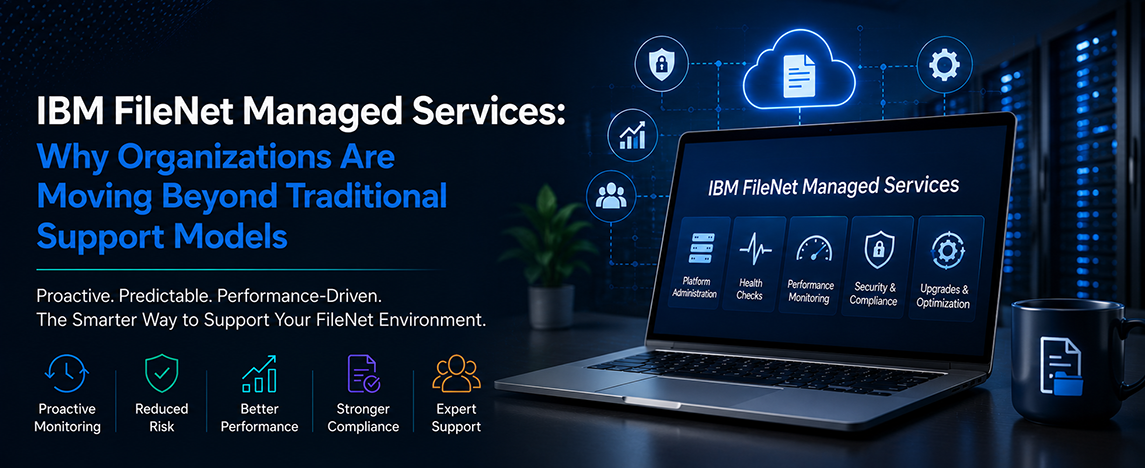
Managed Services are not simply outsourced support.
A mature FileNet Managed Services model introduces:
Proactive Monitoring
Issues are identified before they impact users.
Team-Based Expertise
Knowledge is distributed across multiple specialists rather than concentrated in one individual.
Expertise Across Legacy and Current IBM FileNet Versions
Many organizations continue to operate a mix of legacy and modern IBM FileNet environments.
Whether you’re running an older, business-critical implementation or a recently upgraded platform, our specialists bring experience across multiple FileNet versions.
This enables organizations to:
- Maintain stability in legacy environments
- Support ongoing upgrades
- Reduce operational risk during modernization
- Plan future migration initiatives with confidence
Our goal is to help organizations maximize the value of their existing FileNet investment while preparing for future business and technology requirements.
Governance and Accountability
Service levels, reporting, reviews, and escalation processes create operational transparency.
Continuous Improvement
The environment is regularly reviewed and optimized rather than merely maintained.
Business Continuity
Operations continue smoothly regardless of staffing changes or resource availability.
Why Flexible Managed Services Deliver Better Cost Control
Traditional support models often require organizations to maintain fixed internal resources regardless of workload.
Managed Services offer a more flexible operating model.
Organizations can:
Ramp Up Resources
Increase specialist support during:
- Platform upgrades
- Migration projects
- Major releases
- Compliance initiatives
- Performance optimization activities
Ramp Down Resources
Reduce operational support once projects are completed, avoiding unnecessary long-term staffing costs.
This flexibility allows organizations to align operational spending with actual business demand instead of maintaining excess capacity throughout the year.
The result is a more predictable and cost-effective support model.
Calculating the Real Cost of FileNet Operations
Organizations should evaluate more than direct technology expenses.
Questions worth asking include:
- How much downtime occurred during the past year?
- How long did incidents take to resolve?
- How dependent are we on individual resources?
- How many strategic projects were delayed because teams were focused on support?
- How confident are we in our compliance posture?
- How quickly could we recover from the loss of key personnel?
The answers often reveal costs that traditional budgeting processes overlook.
Reactive Support vs. Managed Services: The Hidden Cost Comparison
| Business Area | Reactive Support Model | Managed Services Model |
|---|---|---|
| Issue Detection | Problems are addressed after users report them | Continuous monitoring identifies and resolves issues proactively |
| Operational Costs | Costs increase due to recurring incidents and firefighting | Predictable operating costs through proactive management |
| FileNet Expertise | Knowledge resides with one or two individuals | Cross-trained specialists with shared ownership and documentation |
| Security & Compliance | Periodic reviews and reactive updates | Continuous governance, security reviews, and compliance oversight |
| Platform Performance | Performance tuning occurs only after complaints | Ongoing health checks and proactive optimization |
| Scalability | Fixed internal staffing regardless of workload | Flexible ramp-up and ramp-down support aligned to business needs |
| Business Continuity | High dependency on key personnel | Team-based delivery with documented processes and continuity planning |
| Strategic Focus | Internal teams spend time on operational issues | Internal teams focus on modernization and business transformation |
The difference isn't simply how IBM FileNet is supported—it's how the platform is operated. Organizations that adopt a proactive managed services model shift from reacting to incidents to continuously improving platform stability, security, and operational resilience.
Frequently Asked Questions
How can Managed Services reduce the total cost of running IBM FileNet
Managed Services help reduce the total cost of ownership by minimizing unplanned downtime, improving operational efficiency, reducing dependency on specialized internal resources, optimizing platform performance, and proactively identifying issues before they become costly incidents. Instead of reacting to problems, organizations invest in preventing them.
Is hiring a full-time FileNet administrator more cost-effective than Managed Services?
Not always.
Building and maintaining in-house FileNet expertise involves recruitment, onboarding, ongoing training, employee retention, and succession planning. Managed Services provide access to a team of specialists, allowing organizations to benefit from broader expertise without the long-term cost and risk associated with maintaining a dedicated internal team.
Can Managed Services scale as our business requirements change?
Yes.
One of the key advantages of Managed Services is operational flexibility. Organizations can increase support during upgrades, modernization initiatives, audits, or peak business periods, and reduce support once those activities are complete. This flexible model helps align costs with actual business demand.
Can Managed Services support both legacy and current IBM FileNet environments?
Yes.
Many enterprises continue to operate older FileNet versions alongside newer environments. Managed Services can provide administration, monitoring, optimization, and operational support across both legacy and current versions, helping organizations maintain stability while planning future upgrades or modernization initiatives.
How do Managed Services improve the security of IBM FileNet?
Managed Services strengthen security through proactive monitoring, access governance, regular platform health reviews, security best practices, support for patch planning, audit readiness, and ongoing operational oversight. The goal is to reduce operational and compliance risks while helping organizations maintain a secure and reliable FileNet environment.
What is the biggest hidden cost of managing IBM FileNet internally?
For many organizations, it is not infrastructure or licensing—it is the accumulation of operational risk. Reactive support, knowledge dependency, delayed issue resolution, security exposure, compliance challenges, and limited scalability can significantly increase the long-term cost of maintaining the platform.
Ask Yourself
If your FileNet administrator were unavailable tomorrow:
- Could your team confidently resolve a critical production issue?
- Is your platform documentation current and complete?
- Can you scale support during upgrades or audits without hiring?
- Do you have visibility into the true operational cost of FileNet?
If any of these questions raise concerns, it may be time to reassess your FileNet operating model.
Final Thoughts
The visible costs of running IBM FileNet are only part of the story.
The larger costs often remain hidden within operational inefficiencies, knowledge dependencies, downtime, compliance risks, and delayed business initiatives.
Organizations that continue relying on reactive support models often find themselves investing increasing amounts of time and money simply to maintain the status quo.
Those that adopt a proactive, governed managed services approach position themselves differently.
They gain operational stability.
They reduce risk.
They improve business continuity.
And most importantly, they free their teams to focus on initiatives that create business value rather than simply keeping systems running.
The question is not how much your FileNet environment costs today.
The question is whether you understand what it is truly costing your organization.
Ready to Reduce the Hidden Costs of FileNet?
If your organization is spending too much time reacting to FileNet issues, struggling with knowledge gaps, or delaying strategic initiatives because internal teams are overloaded, it may be time to explore a managed services approach.
A FileNet Managed Services partner can help you improve stability, reduce operational risk, and create more room for innovation.