IBM Content Cortex
IBM Content Cortex for AI-Ready FileNet Modernization
Prepare your IBM FileNet environment for AI adoption with a structured strategy for content modernization, AI integration, and enterprise governance.
ECM Addons helps organizations assess existing IBM FileNet environments, evaluate AI integration opportunities, and develop practical modernization roadmaps for intelligent, governed content operations.
Move beyond traditional document management toward AI-ready enterprise content, connected applications, and intelligent workflows—while planning for security, compliance, and business continuity.
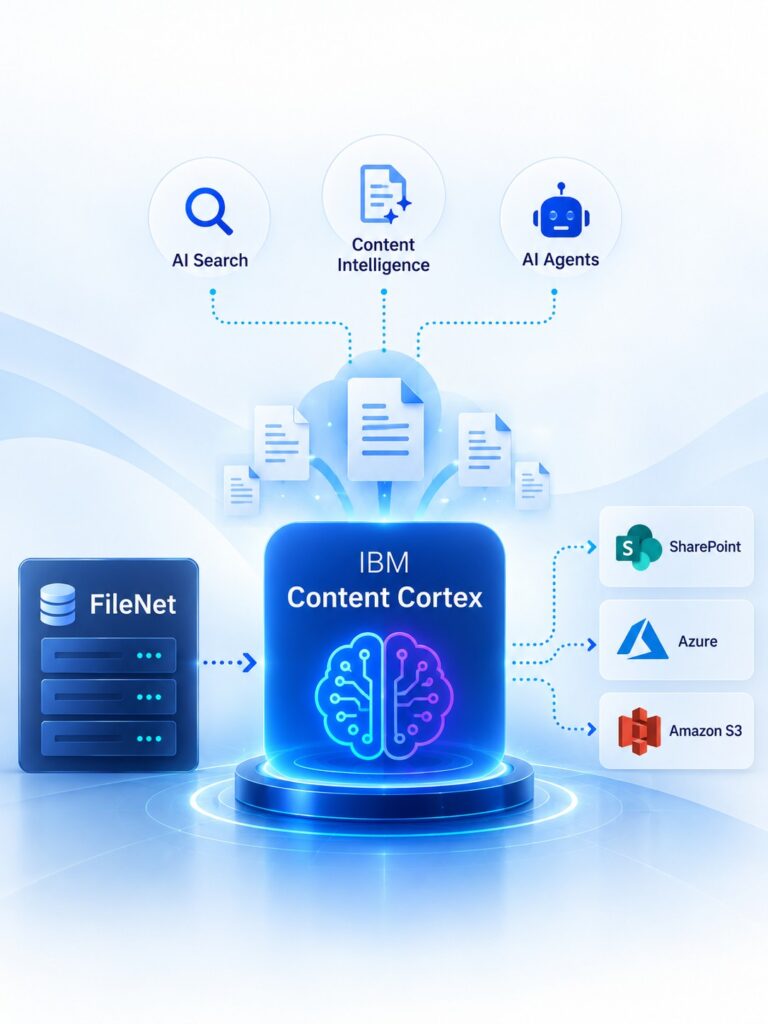
What Is IBM Content Cortex?
Transform Enterprise Content into an AI-Ready Business Asset
IBM Content Cortex represents an evolution of enterprise content services, bringing content management capabilities together with AI-enabled interactions, intelligent content operations, and support for compatible AI applications and agents.
Enterprise content contains valuable business knowledge, but documents and records can be difficult to discover and use effectively when information is distributed across repositories, metadata structures, and business applications.
IBM Content Cortex introduces capabilities that can help organizations make enterprise information more accessible through intelligent search, natural-language content operations, enhanced text extraction, and supported AI agent integration.
For organizations using IBM FileNet Content Manager, this creates an opportunity to evaluate how existing content, integrations, security policies, and business processes can support their AI adoption strategy.
ECM Addons helps organizations assess their current environment, identify modernization opportunities, and plan a practical path toward AI-ready enterprise content.
Key IBM Content Cortex Capabilities for Enterprise AI Adoption
IBM Content Cortex brings together content services and AI-enabled capabilities that can help organizations improve information discovery, simplify content operations, and explore new AI-powered business use cases.
Connect compatible AI applications and agents with supported enterprise content services through Remote Model Context Protocol (MCP) connectivity. This enables supported content interactions through compatible interfaces, subject to configuration, permissions, and technical requirements.
Business value: Explore AI agent use cases that connect enterprise knowledge with business applications and workflows.
Enable users to interact with enterprise content through natural-language instructions in supported IBM Content Navigator experiences. Depending on the available capabilities, users can perform content-related tasks such as finding documents, organizing folders, and managing metadata.
Business value: Simplify content interactions and reduce reliance on manual navigation for supported tasks.
Improve information discovery through intelligent search and AI-assisted document processing. Depending on the selected capabilities and configuration, use cases may include document summarization, information extraction, classification, and question-based discovery.
Business value: Help employees find relevant information and make better use of enterprise knowledge.
Manage active and historical content through integrated archiving and retrieval capabilities. Evaluate opportunities to improve storage efficiency while preserving access to business-critical information and supporting applicable retention requirements.
Business value: Support long-term information access, content lifecycle management, and storage optimization.
Use operational insights and relevant performance indicators to understand content activity, identify bottlenecks, and evaluate opportunities to improve content-driven processes.
Business value: Make informed decisions about operational improvements and modernization priorities.
Plan AI adoption around enterprise access controls, retention policies, records management, auditability, and applicable compliance requirements. Evaluate how existing governance controls apply to supported AI interactions and content representations.
Business value: Introduce AI-enabled content operations within an appropriate enterprise governance framework.
Evaluate enhanced text extraction capabilities for scanned documents, image-based files, handwriting, and complex tables. Making previously difficult-to-search information accessible can support downstream content discovery and AI processing.
Business value: Help unlock information that may otherwise remain difficult to discover or use in AI-enabled workflows.
Specific capabilities, availability, prerequisites, and outcomes depend on the applicable IBM products, versions, licensing, and configuration.
IBM Content Cortex vs. FileNet: Understanding the Differences
Traditional IBM FileNet environments provide enterprise content management capabilities for document storage, metadata, security, records management, workflows, and business application integration.
IBM Content Cortex extends the enterprise content services direction toward AI-enabled content operations, natural-language interactions, intelligent information discovery, and supported AI agent connectivity.
Understanding the differences helps organizations evaluate how their existing content environment can evolve to support AI adoption.
| Area | Traditional FileNet environment | AI-enabled content operations with Content Cortex |
|---|---|---|
| Content access | Document retrieval and established search capabilities | Opportunities for more intelligent content discovery |
| Content operations | Repository interfaces and configured business processes | Natural-language interactions for supported tasks |
| AI integration | Integration approaches based on the existing architecture | Supported MCP connectivity for compatible AI applications and agents |
| Document processing | Existing indexing, classification, and processing capabilities | Additional AI-enabled processing opportunities where supported |
| Governance | Established security, records, and access controls | Governance requirements extending to supported AI interactions |
| Modernization | Optimization, upgrades, and integration improvements | Assessment of AI adoption opportunities and target-state architecture |
The objective is not necessarily to replace every existing FileNet capability. It is to understand how the current environment, supported Content Cortex capabilities, and AI applications can work together to meet business requirements.
The appropriate transition strategy depends on your current IBM products, supported architecture, compatibility requirements, licensing, and modernization objectives.
IBM FileNet Modernization: Preparing for AI Adoption
Modernize Your Content Environment with a Clear Strategy
IBM FileNet modernization is an important consideration for organizations seeking to improve content operations, address legacy dependencies, and prepare enterprise information for AI adoption.
Existing environments may contain years of documents, custom metadata, workflows, records policies, and integrations with SAP and other business-critical applications. These dependencies need to be understood before defining a target architecture.
ECM Addons helps organizations evaluate their IBM FileNet Content Manager environments and identify opportunities for modernization, AI integration, and operational improvement.
Our assessment considers:
Content and metadata: Object Stores, document volumes, content types, metadata structures, versions, and retention requirements.
AI readiness: Information discoverability, content quality, text extraction needs, and potential AI use cases.
Applications and integrations: SAP integrations, business applications, custom APIs, workflows, and downstream dependencies.
Security and governance: Access permissions, records policies, legal holds, audit requirements, and compliance considerations.
Infrastructure and operations: FileNet versions, deployment architecture, customizations, performance, availability, and support requirements.
Target architecture: Supported Content Cortex capabilities, integration options, migration considerations, and implementation prerequisites.
The result is a structured view of your current environment, key dependencies, potential risks, and recommended next steps.
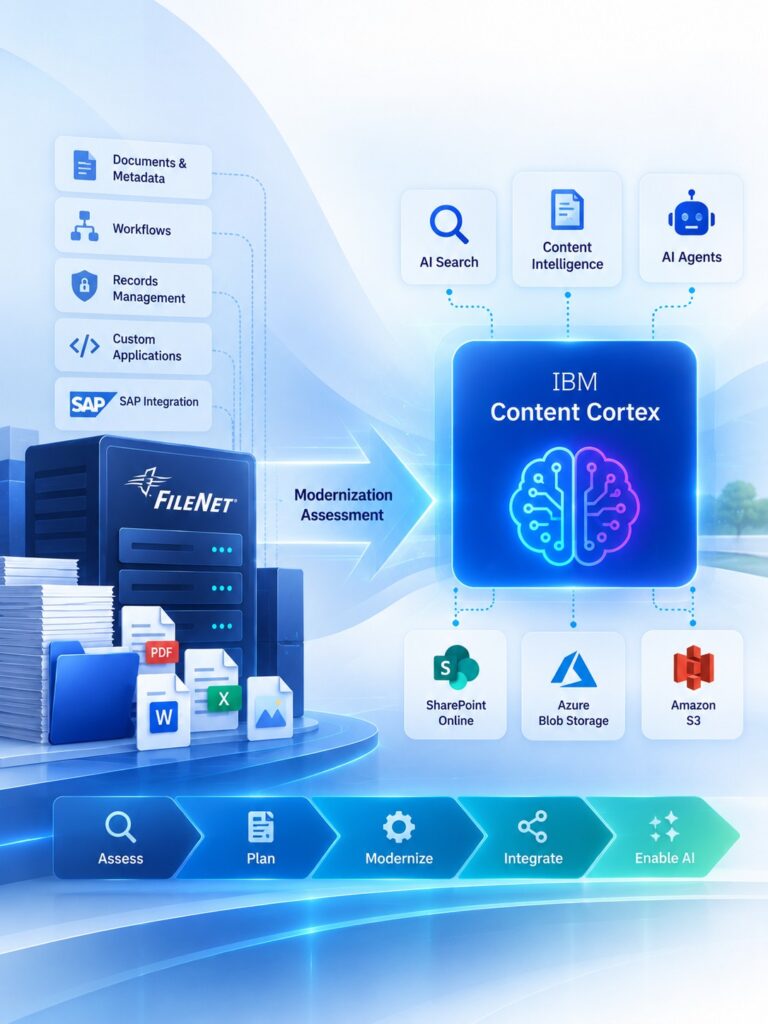
How Can Enterprises Plan Their FileNet P8 Modernization Roadmap?
A successful FileNet P8 modernization initiative requires more than a technology upgrade. It involves evaluating existing business processes, content dependencies, integration requirements, and the opportunities created by AI-enabled content services. ECM Addons helps organizations develop a phased roadmap aligned with their technical environment and business priorities.
Review FileNet P8 architecture, Object Stores, document volumes, metadata, customizations, workflows, integrations, and operational requirements.
Establish a baseline of technical dependencies and operational requirements.
Identify potential use cases for intelligent search, document understanding, natural-language content operations, and supported AI agent interactions. Prioritize opportunities based on business value, feasibility, and risk.
Assess application integrations, SAP dependencies, security controls, records policies, infrastructure, and product compatibility requirements.
Determine how the existing FileNet environment, supported Content Cortex capabilities, AI services, and enterprise applications should work together.
Define implementation priorities, migration requirements, dependencies, licensing considerations, testing, and rollout sequencing. Where appropriate, validate a prioritized use case through a proof of value.
Plan content integrity checks, metadata validation, access control testing, integration validation, user acceptance, monitoring, and operational support.
Conduct functional and user acceptance testing, resolve identified issues, and establish rollback and operational support procedures before production cutover.
Outcome: A practical modernization roadmap that connects AI adoption objectives with technical readiness, governance, implementation requirements, and business priorities.
Why Choose ECM Addons for IBM Content Cortex Modernization?
Combine FileNet Expertise with an AI-First Modernization Approach
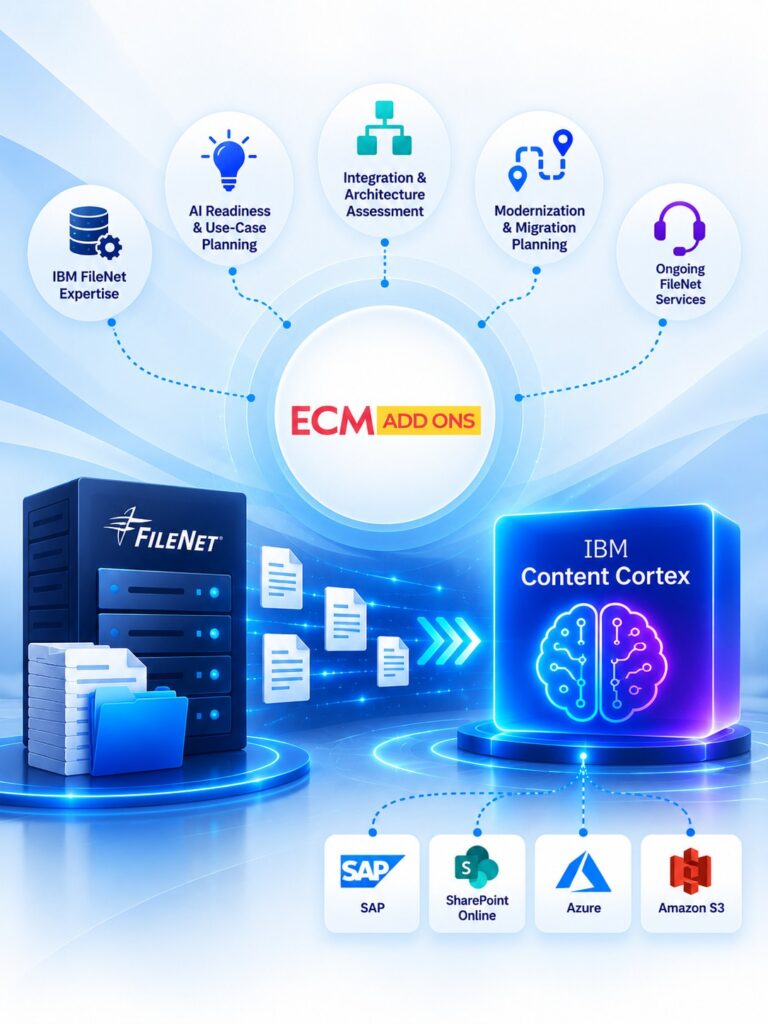
Successful AI adoption in enterprise content environments requires an understanding of both emerging AI capabilities and the existing systems that manage business-critical information.
ECM Addons brings an enterprise content management focus to modernization planning, helping organizations evaluate their current IBM FileNet environment and identify practical next steps toward AI-enabled content operations.
IBM FileNet expertise
Assess repositories, Object Stores, metadata, workflows, customizations, and existing application dependencies.
AI readiness and use-case planning
Identify opportunities for intelligent search, content processing, and supported AI agent interactions based on business priorities.
Integration and architecture assessment
Evaluate SAP integrations, business-critical applications, APIs, workflows, security requirements, and target-state dependencies.
Modernization and migration planning
Define transition options, implementation priorities, technical dependencies, validation requirements, and phased roadmaps.
Ongoing FileNet services
Support existing environments through managed services, technical support, health checks, upgrades, and operational improvements.
Whether you are exploring AI for the first time or planning a broader FileNet modernization initiative, ECM Addons can help establish the technical and operational foundations for your next steps.
Plan Your IBM Content Cortex Modernization Strategy
Are you running IBM FileNet and evaluating how IBM Content Cortex fits into your enterprise content roadmap?
ECM Addons can help you assess your current environment, identify technical dependencies, and develop a structured modernization plan aligned with your business, integration, security, and operational requirements. Share your current FileNet version, deployment model, key integrations, and modernization objectives to begin a focused technical discussion.
Frequently Asked Questions
IBM Content Cortex represents an evolution of enterprise content services toward AI-enabled content operations, intelligent information discovery, and supported AI agent interactions. It helps organizations evaluate how enterprise content can be made more accessible to people and compatible AI applications.
Traditional FileNet environments provide core enterprise content management capabilities, including document storage, metadata, security, records management, and application integration. Content Cortex extends the enterprise content services direction toward AI-enabled interactions and supported agent connectivity. The specific differences depend on the products, versions, and configurations involved.
Not necessarily. The appropriate modernization approach depends on the current IBM products, target architecture, compatibility, licensing, and business objectives. Organizations should evaluate supported transition options before deciding whether migration, integration changes, or incremental modernization is required.
An assessment should examine the existing FileNet environment, content and metadata, application integrations, security and records policies, infrastructure, AI use cases, and applicable product prerequisites. The findings can inform a prioritized implementation or modernization roadmap.
Implementation planning typically includes use-case definition, compatibility assessment, architecture design, integration planning, security and governance evaluation, testing, and deployment preparation. Actual requirements depend on the selected capabilities and existing environment.
Supported MCP connectivity can provide compatible AI applications and agents with access to supported enterprise content services. The available operations depend on the interface, configuration, permissions, and compatibility requirements.
Enhanced text extraction can help make information in scanned documents and image-based files more accessible for search and AI processing. Results depend on the document quality, extraction technology, and applicable configuration.
Organizations should evaluate how access controls, records policies, retention requirements, and auditability apply to supported AI interactions. Appropriate governance and security measures are essential when enterprise information is made available to AI applications.
Costs depend on applicable licensing, infrastructure, integration complexity, migration scope, selected capabilities, testing, and ongoing support. An assessment of the current environment and target requirements can help identify the main cost drivers.
The timeline depends on the existing environment, implementation scope, supported product capabilities, integration dependencies, and validation requirements. A readiness assessment can help establish a realistic phased schedule.
Explore Your IBM FileNet Modernization Options
Choose the Right Path for Your Enterprise Content
Not every organization is ready to adopt IBM Content Cortex. Your existing infrastructure, business applications, licensing, and modernization priorities will influence the right approach. Whether you want to prepare for AI adoption, continue managing your existing FileNet environment, or migrate to Microsoft SharePoint, ECM Addons can help you plan the next step.
IBM Content Cortex Modernization
Prepare Your FileNet Environment for AI
Assess your existing IBM FileNet environment, identify AI adoption opportunities, and develop a practical roadmap for IBM Content Cortex implementation and integration.
IBM FileNet Managed Services
Keep Your FileNet Environment Running Smoothly
Maintain and optimize your existing IBM FileNet environment with managed services, technical support, health checks, performance optimization, upgrades, and ongoing maintenance.
IBM FileNet to SharePoint Migration
Move Enterprise Content to Microsoft SharePoint
Plan and execute your IBM FileNet to SharePoint migration with a structured approach to content discovery, extraction, metadata mapping, migration, and validation.
Address integration dependencies, security, records management, and business continuity as part of your migration strategy.