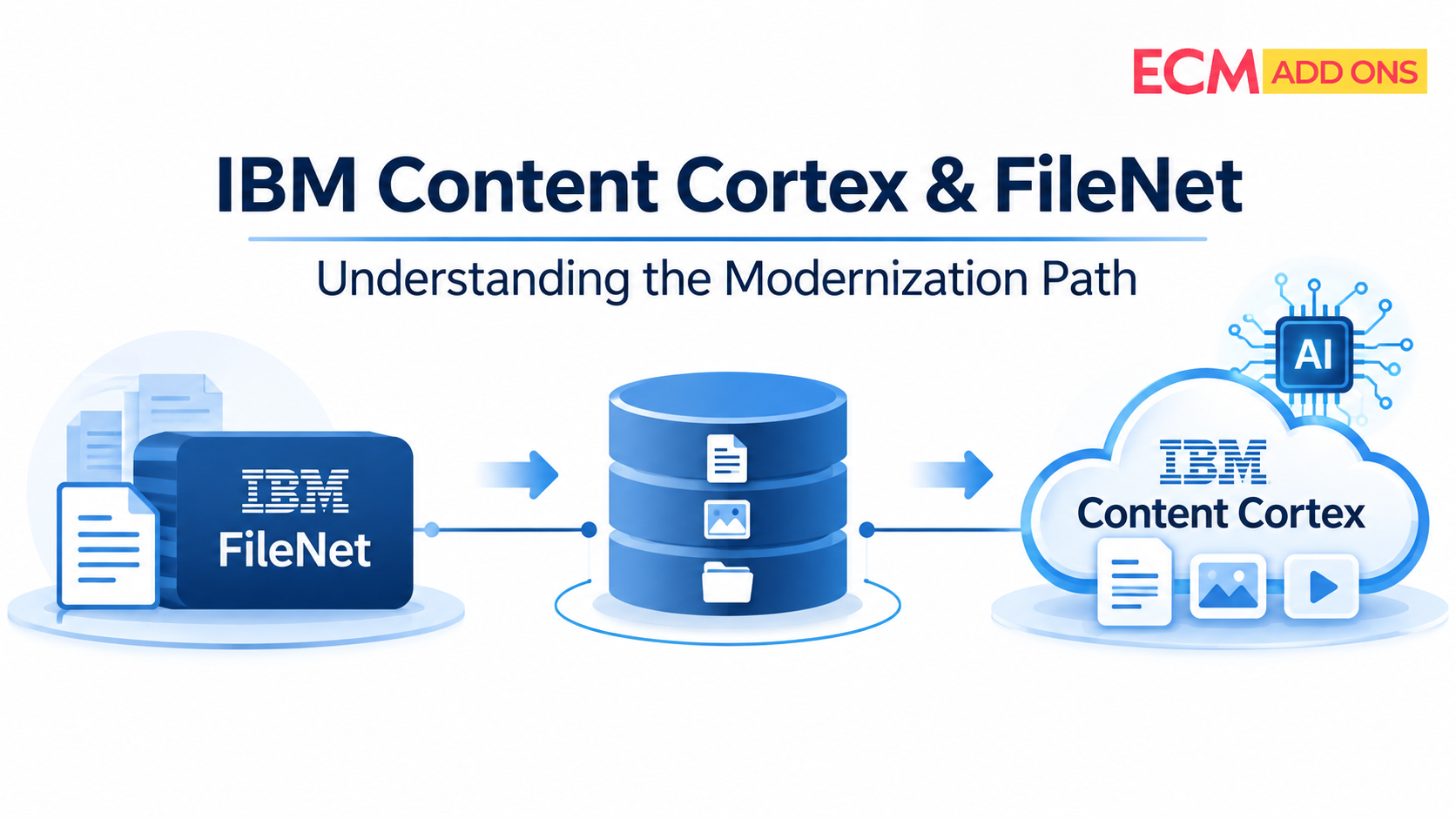
IBM Content Cortex vs FileNet is an important comparison for organizations planning to modernize their enterprise content management (ECM) environments. For existing IBM FileNet Content Manager customers, the key question is how Content Cortex builds on the existing content services foundation and what changes modernization may require.
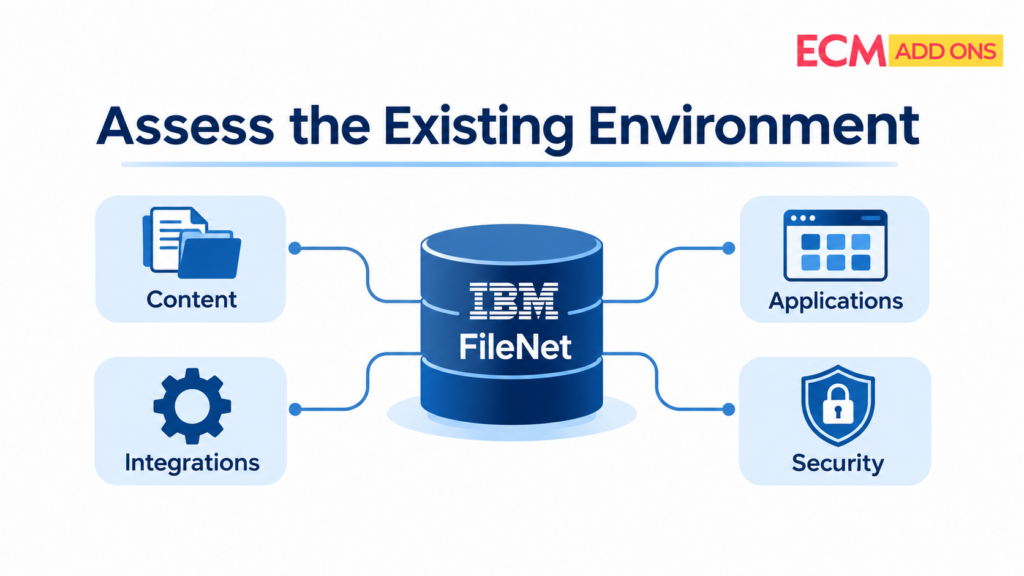
Existing FileNet environments often depend on object stores, document classes, business applications, security policies, business automation workflows, APIs, and integrations with business applications. Understanding these dependencies is essential to assessing compatibility, identifying adaptation requirements, and planning a practical modernization path.
Content Cortex introduces additional AI-enabled content capabilities, but the benefits depend on the organization’s requirements, deployment model, available features, and licensing. Some enterprises may prioritize FileNet stability, supportability, and upgrade planning, while others may explore AI-assisted content discovery or classification.
This guide examines the technical differences between Content Cortex and existing FileNet environments, the key factors to assess before modernization, and when Microsoft SharePoint Online may be worth evaluating as an alternative. The goal is to help organizations make informed decisions based on architecture, business needs, and long-term technology strategy.
What Is IBM Content Cortex?
IBM Content Cortex is IBM’s next-generation content services platform, evolving FileNet Content Manager with AI-powered information access and intelligent automation. It aims to make enterprise content more accessible and useful to both people and AI agents while building on established content management capabilities.
Traditional enterprise content management focuses on storing, securing, classifying, retrieving, and governing documents. Content Cortex extends this foundation with capabilities that can help organizations:
- AI-assisted content discovery: Find relevant information beyond conventional keyword searches.
- Document classification and metadata enrichment: Improve document identification and organization.
- Intelligent content operations: Support selected activities such as classification, redaction, and legal hold.
- Governed AI access: Apply appropriate security and governance controls when interacting with enterprise content.
For existing FileNet customers, Content Cortex offers an opportunity to explore new capabilities while considering investments in repositories, applications, and security. Available features depend on the product edition, deployment, and configuration. Organizations should assess their requirements, licensing, and technical readiness before deciding which capabilities to adopt.
How IBM Content Cortex Affects Existing FileNet Content Manager Environments
The first step is to distinguish between the evolution of FileNet Content Manager and the modernization requirements of other IBM content management products. These scenarios should not be treated as identical.
Existing IBM FileNet Content Manager Environments
For organizations already running IBM FileNet Content Manager, Content Cortex represents a continuation of the established content services platform through IBM’s product evolution and upgrade path. Existing investments in content management, security, and business applications remain important considerations when planning the transition.
However, organizations should not assume that every upgrade is a simple name change with no technical work. The actual effort depends on the current release, deployment architecture, supporting software, customizations, integrations, and target version.
IT teams should review the applicable upgrade path and establish what needs to change before scheduling production work. This helps prevent avoidable compatibility problems and allows business owners to plan testing and operational readiness.
Organizations Using Other IBM Content Management Products
Organizations running products such as IBM Content Manager OnDemand or IBM Content Manager Enterprise Edition should assess their modernization options separately.
For these customers, planning may involve more substantial technical or architectural changes than an upgrade of an existing FileNet Content Manager environment. Repository structures, application dependencies, integrations, and content access requirements must be evaluated before a transition strategy is selected.
The key takeaway is simple: identify the exact IBM product and configuration before deciding what modernization requires.
IBM Content Cortex vs FileNet: What Is Actually Changing?
The key difference in IBM Content Cortex vs FileNet is not simply a change of product name. Content Cortex builds on IBM’s FileNet content services foundation, with an emphasis on extending traditional content management through AI-enabled capabilities and more intelligent content operations.
In an existing FileNet environment, core components may include object stores, document classes, property templates, security policies, workflows, and integrations with business applications. Modernization therefore requires understanding how these components interact, not just comparing feature lists.
The technical assessment should focus on three areas:
- Content architecture: Review object stores, document classes, metadata properties, content relationships, and repository dependencies to understand what must be retained or adapted.
- Applications and integrations: Evaluate workflows, APIs, custom applications, and connected systems to identify compatibility requirements and potential changes.
- AI and operational capabilities: Determine which Content Cortex capabilities are available for the intended deployment, what configuration or licensing they require, and how they fit existing governance and security controls.
For some organizations, the priority may be maintaining a stable FileNet environment while planning upgrades. Others may have a clear use case for AI-assisted content discovery or classification. The appropriate path depends on the current architecture, product roadmap, technical constraints, and business objectives-not the product name alone.
Why FileNet Modernization Requires More Than a Version Upgrade
FileNet environments often evolve over many years. Organizations may have accumulated custom applications, specialized workflows, integrations with ERP or CRM systems, and security rules designed around specific business processes. These dependencies can make modernization more complex than installing a newer release.
A successful IBM FileNet modernization strategy needs to address the wider environment, including how documents are accessed, how applications reference content, and how security and governance requirements are maintained.
Review Existing Applications and Integrations
Applications may rely on FileNet APIs, object identifiers, metadata properties, or repository-specific behavior. Before upgrading or introducing new content capabilities, teams should identify these dependencies and determine what must be tested or adapted.
The assessment should also include related components such as IBM Content Navigator, Datacap, workflow solutions, and custom applications where they are present. Their role and compatibility must be verified against the intended target architecture rather than assumed.
Assess Metadata, Permissions, and Governance
Document metadata and security controls influence how users locate information and determine who can access it. Changes to the content platform or surrounding architecture must account for these requirements.
Organizations should document important metadata, access rules, retention requirements, and audit expectations before implementation. Where changes are necessary, they should be tested against real business scenarios to confirm that the intended controls remain effective
Plan for Deployment and Operational Readiness
An upgrade or modernization may require changes to infrastructure, supporting software, deployment configuration, or operational procedures. Teams need to understand these requirements early enough to plan resources, testing, backups, recovery procedures, and production cutover.
The objective is to avoid treating modernization as an isolated technical activity. It should be planned as a controlled change to a business-critical service.
Exploring the Next Stage of IBM FileNet Modernization?
IBM Content Cortex provides an evolution path for organizations looking to extend their existing IBM content management capabilities with AI-powered content services. Before deciding on the transition, evaluate how your existing FileNet applications, integrations, workflows, security, and governance requirements align with the Content Cortex architecture.
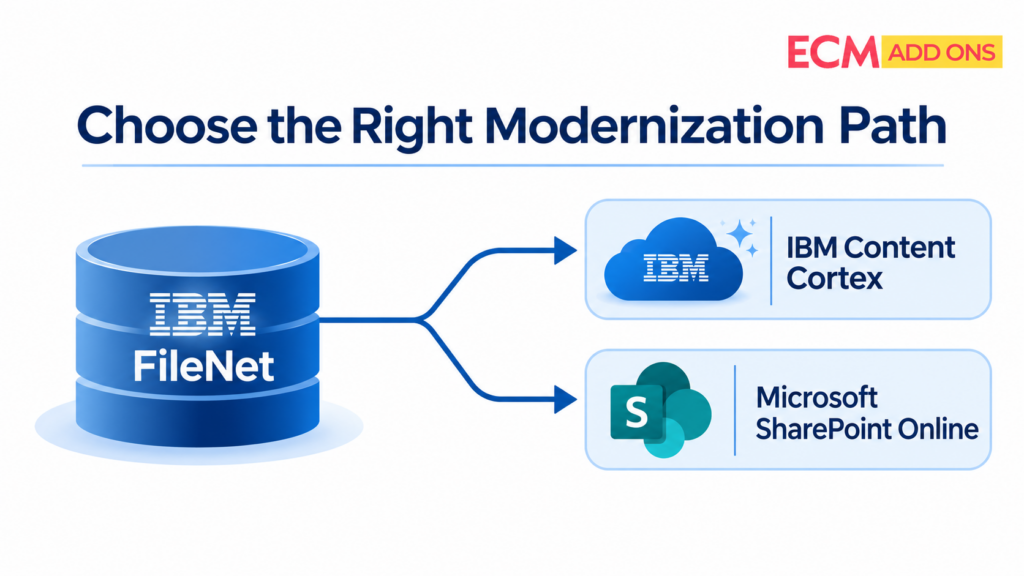
Should You Modernize FileNet with Content Cortex or Migrate to SharePoint Online?
Not every organization needs the same destination. For some enterprises, extending their existing IBM content management environment may be the most practical choice. Others may find that Microsoft SharePoint Online better aligns with their enterprise content strategy, Microsoft 365 investments, and future operating model.
The decision should be based on the capabilities the business requires, the complexity of the current environment, and the total effort involved in reaching the target state.
When Content Cortex May Be the Right Direction
Content Cortex is worth evaluating when an organization wants to build on its existing IBM content services foundation and explore IBM’s evolving AI and content automation capabilities.
This route may be appropriate when FileNet continues to meet core business requirements, existing applications are closely coupled to the platform, and the organization wants to modernize without undertaking a separate content migration solely because of the product announcement.
The assessment should still establish the applicable upgrade path, deployment requirements, licensing terms, and the business value expected from additional capabilities
When FileNet-to-SharePoint Online Migration May Be Worth Exploring
A migration to SharePoint Online may be appropriate when an organization is reassessing its enterprise content architecture and wants to align document management with its Microsoft 365 strategy. It may also be worth evaluating when the current platform’s support model, operating costs, or long-term direction no longer fits business priorities.
However, SharePoint Online is not a direct one-to-one replacement for every FileNet capability. A migration may require changes to information architecture, permissions, workflows, integrations, records management, and custom applications.
Before choosing this route, organizations should establish:
- Which documents, metadata, and business capabilities must be carried forward.
- How FileNet workflows and connected applications will be handled.
- How the SharePoint Online security and governance model will meet business requirements.
- What migration, testing, remediation, and operational costs should be included.
The goal is not to migrate simply because a new product has been introduced. It is to choose the platform and architecture that best support the organization’s long-term requirements.
The Importance of a FileNet Migration Assessment
Whether an organization is considering IBM Content Cortex or exploring SharePoint Online, understanding the current environment is essential. Decisions made without adequate discovery can overlook hidden dependencies, create unrealistic budgets, and lead to unnecessary rework.
A FileNet migration assessment helps establish what exists today and what the proposed future environment needs to support. It can examine repository structures, document classes, metadata, content volumes, security, customizations, and application dependencies, depending on the assessment scope and available information.
This baseline helps teams determine which parts of the environment can follow a relatively straightforward path and which require further technical investigation. It also supports a more realistic comparison of modernization options, including the work needed to retain existing capabilities or implement them differently in a new platform.
Evaluate Your FileNet Modernization Readiness
Before deciding whether to adopt IBM Content Cortex or pursue another modernization path, organizations need a clear understanding of their current FileNet architecture, application dependencies, and operational requirements.
ECM Addons helps organizations assess their existing enterprise content management environments and understand the technical considerations involved in modernization. An expert discussion can help identify key assessment areas, clarify project priorities, and determine the appropriate next steps based on your environment.
How ECM Addons Helps Organizations Evaluate Their Next Step
Choosing between IBM Content Cortex modernization and FileNet-to-SharePoint Online migration requires an understanding of both the source environment and the potential destination. ECM Addons specializes in enterprise content management, with experience across IBM FileNet and Microsoft SharePoint Online.
This cross-platform experience helps organizations examine their current FileNet dependencies and evaluate what a SharePoint Online migration would involve when it aligns with their strategy. Instead of assuming that all content or functionality can move directly, the assessment considers the structures, access requirements, integrations, and business processes that need to be addressed.
A cost-conscious approach begins with identifying the actual scope of work. Discovery, migration prioritization, appropriate automation, and early validation can help reduce avoidable effort and make project costs easier to assess. The appropriate approach will depend on the complexity of the existing environment and the requirements of the target platform.
ECM Addons can help organizations assess their current FileNet landscape, understand migration considerations, and plan a practical path toward SharePoint Online where that is the right strategic fit. For organizations remaining with IBM, product-specific upgrade and licensing decisions should be confirmed against IBM’s applicable documentation and agreements.
Plan Your Next Step in FileNet Modernization
IBM Content Cortex presents an opportunity to explore evolving content management capabilities, but modernization decisions should begin with your existing architecture, business requirements, and long-term technology strategy.
Whether you are evaluating Content Cortex, planning a FileNet upgrade, or considering broader architectural changes, ECM Addons can help you understand the technical considerations and evaluate your options.
Frequently Asked Questions
Is IBM Content Cortex replacing FileNet?
IBM Content Cortex is the evolution of IBM FileNet Content Manager, building on established content services capabilities and adding newer AI-oriented functionality.
Existing customers should review the applicable upgrade and deployment path rather than assume that a separate platform of migration is automatically required.
Do existing FileNet Content Manager customers need to migrate immediately?
Not simply because of the Content Cortex announcement. The appropriate timing depends on the current release, deployment, business requirements, support considerations, and modernization roadmap. Organizations should verify their specific upgrade and licensing requirements with IBM.
What is the difference between IBM Content Cortex and FileNet P8 modernization?
FileNet P8 modernization refers broadly to improving or updating an existing FileNet environment. Depending on the situation, this may involve upgrading the platform, reviewing infrastructure, addressing application dependencies, or evaluating a different content architecture.
Content Cortex is IBM’s evolving content services platform and one possible direction for organizations building on FileNet Content Manager.
Does IBM Content Cortex require a migration to SharePoint?
No. Content Cortex and SharePoint represent different platform directions. Organizations can evaluate Content Cortex to build on their existing IBM content services environment or assess SharePoint migration if it better aligns with their business and technology strategy.
What should be included in a FileNet migration assessment?
An assessment should consider the current IBM product and version, repositories, document classes, metadata, permissions, customizations, application integrations, workflows, content volumes, and business requirements. The scope should reflect the intended target platform and the capabilities that must be retained.
How does IBM Content Cortex integration affect existing applications?
The impact depends on the existing environment, integration methods, deployment, and intended target version. Application dependencies and compatibility should be reviewed and tested before implementation. Organizations should not assume every custom integration will work unchanged in every target configuration.