FileNet P8 Migration Services
Migrate Complex FileNet P8 Environments With Control
Move complex IBM FileNet P8 environments to modern content platforms with a structured, automated migration approach.
ECM Addons provides FileNet P8 migration services to help enterprises migrate content, metadata, document structures, and business context from IBM FileNet P8 to Microsoft SharePoint Online. Our approach combines environment discovery, content transformation, migration automation, and validation to support a controlled transition while accounting for critical business dependencies.
From FileNet P8 Complexity to a Controlled Migration
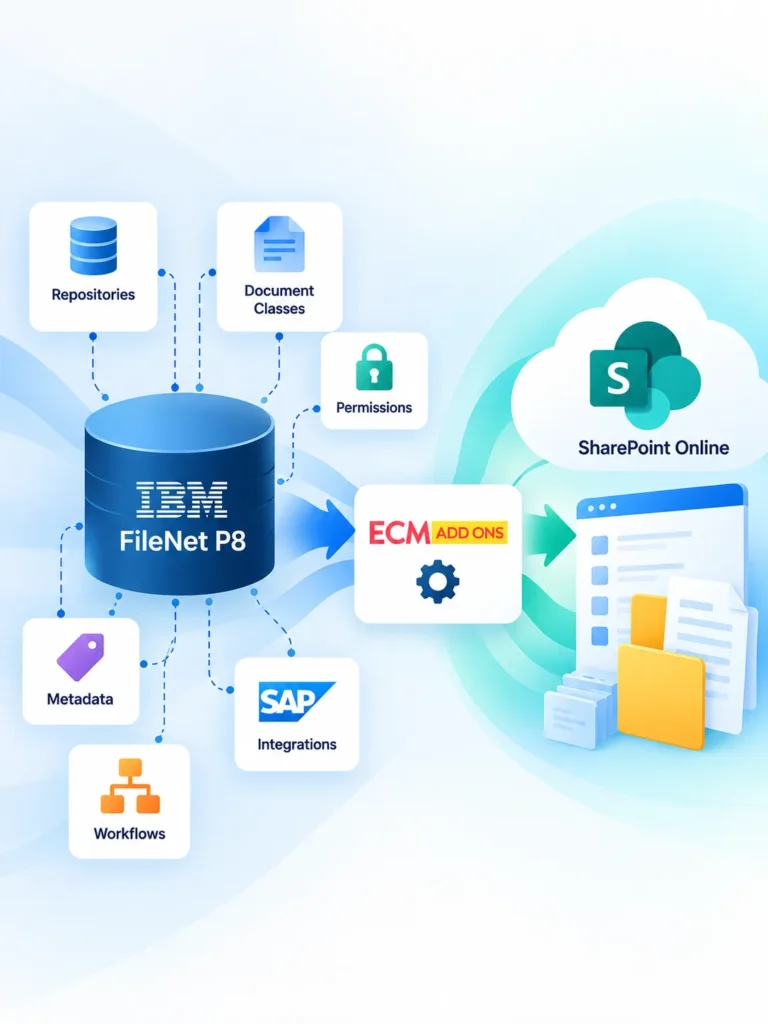
A FileNet P8 migration is rarely just a matter of moving documents from one repository to another.
Content may be distributed across repositories and document classes, governed by complex metadata and permissions, connected to workflows and applications, or integrated with SAP and other enterprise systems.ECM Addons addresses these dependencies before content movement begins-helping establish what needs to move, what needs to change, and how the target environment should support the business.
From FileNet Discovery to Migration Validation
Analyze documents, folders, repositories, classifications, and relationships to determine what should be migrated and how it should be organized in the target environment.
Assess FileNet properties, document classes, and classifications and define appropriate mappings or transformations for the destination.
Identify historical versions and associated information that need to be retained based on business and migration requirements.
Assess FileNet access models and define how relevant permissions and security requirements should be represented in the target platform.
Integrate the destination system with external applications (Databases, ERP and workflow applications).
Perform testing and quality checks with the sample migrated data to guarantee data integrity and system readiness.
Transfer data, documents, workflows and metadata from FileNet to the destination system. Access your legacy content without any loss on the destination system.
Stabilize the new SharePoint environment with post-migration validation, issue resolution, performance monitoring, and user support to ensure a smooth transition.
What Is FileNet P8 Migration Used For?
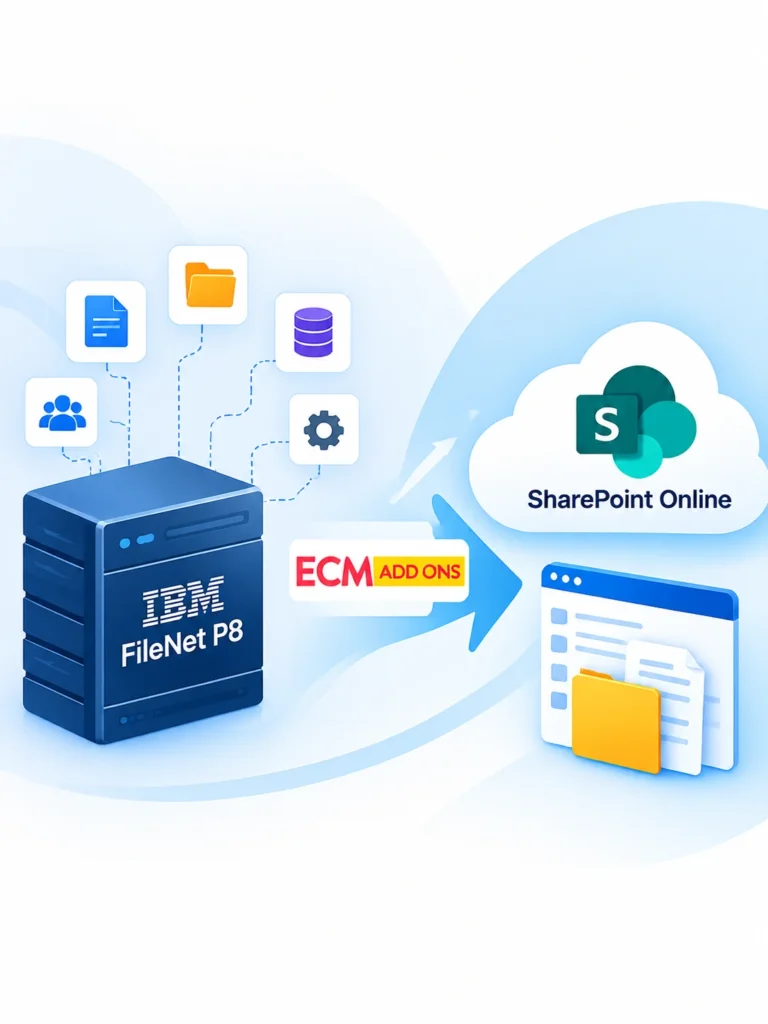
IBM FileNet P8 migration helps enterprises move documents, metadata, and relevant business context to modern content platforms such as Microsoft SharePoint Online and Microsoft 365.
Common use cases include:
Legacy Modernization: Transition from existing FileNet P8 environments to modern content platforms.
Repository Consolidation: Consolidate content across multiple repositories, object stores, and business units.
Enterprise Content Migration: Migrate large volumes of content while accounting for metadata, permissions, workflows, and application dependencies.
ECM Addons provides FileNet P8 migration services supported by migration software to help enterprises plan, automate, and validate their migration.
Planning your FileNet migration? Discuss your migration requirements with our team.
A FileNet P8 Migration Approach Built Around Your Environment
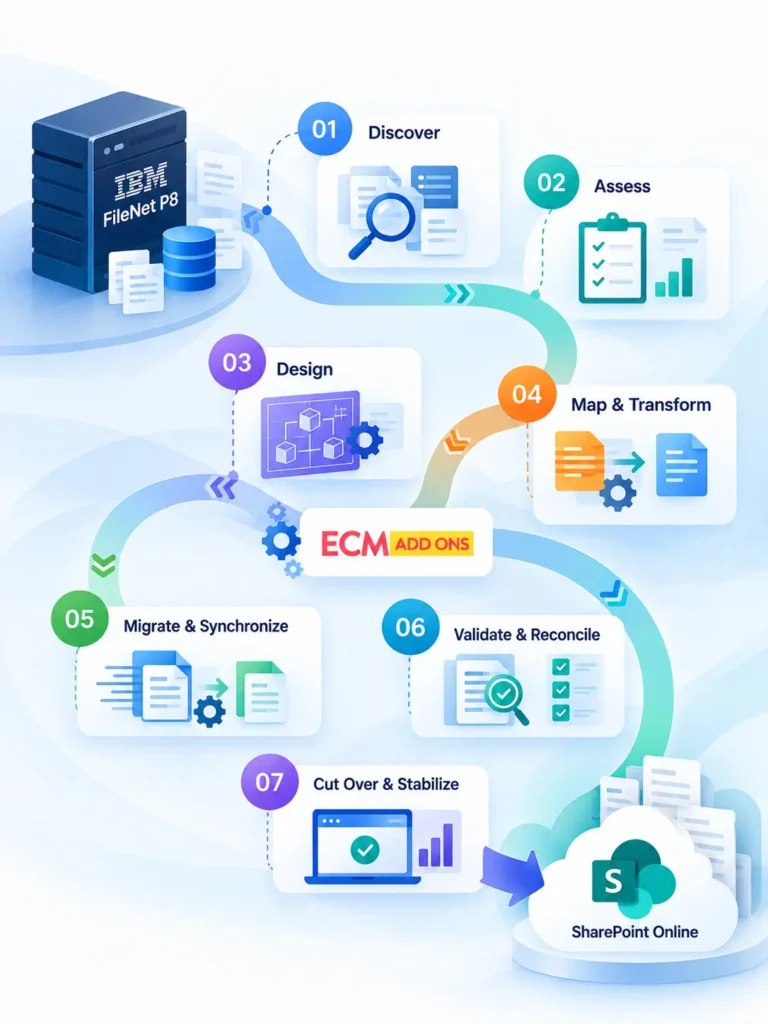
01 - Discover
Analyze repositories, content, document classes, metadata, security, workflows, applications, and integrations to establish the actual FileNet P8 landscape.
02 - Assess
Determine migration scope, dependencies, business requirements, retention considerations, and content that may need to be migrated, transformed, retained, archived, or excluded.
03 - Design
Define the target architecture and migration model based on business requirements rather than simply reproducing the legacy FileNet structure.
04 - Map & Transform
Create rules for content, metadata, classifications, structures, security, and other relevant information. Where one-to-one mapping is unsuitable, transform the source information for the target environment.
05 - Migrate & Synchronize
Use migration automation to execute controlled migration waves and, where required, synchronize source changes before final transition.
06 - Validate & Reconcile
Validate migrated content and associated information against agreed criteria and identify exceptions requiring attention.
07 - Cut Over & Stabilize
Coordinate final synchronization, application readiness, validation, and business requirements before transitioning to the target environment.
Core Capabilities for Enterprise FileNet P8 Migration
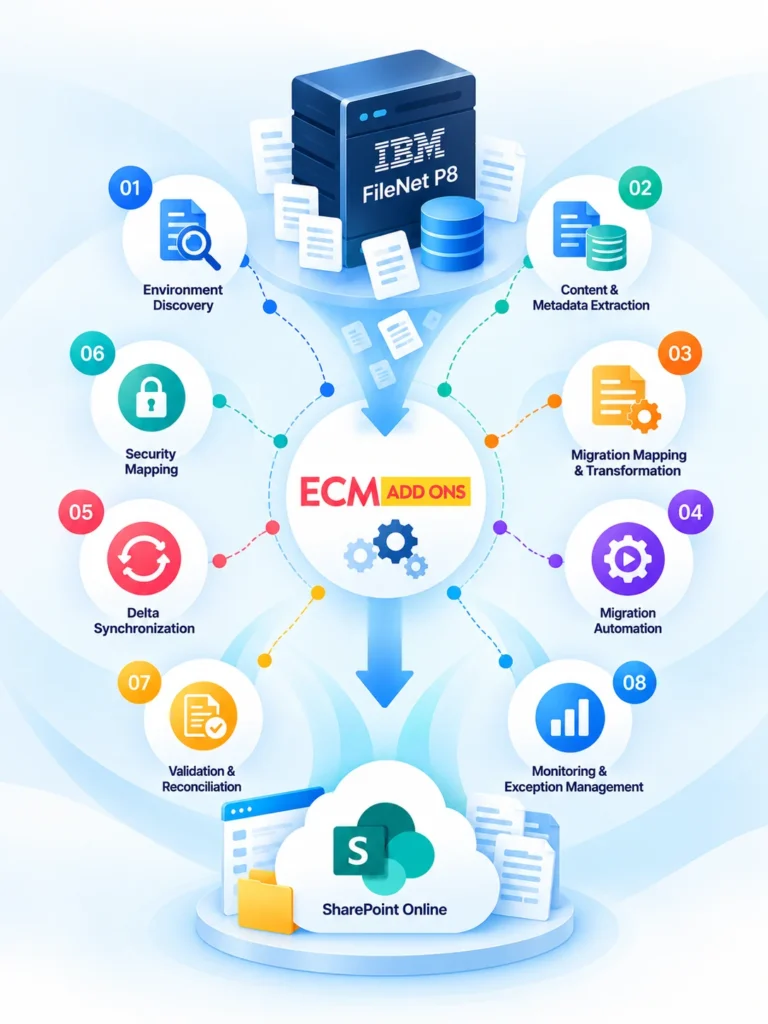
FileNet P8 Environment Discovery
Understand the source environment before defining migration scope.
Content & Metadata Extraction
Extract documents, folders, properties, classifications, and relevant associated information.
Migration Mapping & Transformation
Map FileNet structures and information to the target architecture, including transformation where direct mapping is not appropriate.
Migration Automation
Use purpose-built FileNet P8 migration software to support extraction, transformation, migration, synchronization, monitoring, and reporting.
Security Mapping
Assess source permissions and establish appropriate target security requirements.
Delta Synchronization
Capture relevant source changes between initial migration and final cutover where continued source operation is required.
Validation & Reconciliation
Verify migration results against agreed content, metadata, security, and other migration criteria.
Monitoring & Exception Management
Track migration progress and identify exceptions across migration waves.
FileNet P8 to SharePoint Migration: Designing the Right Target Architecture
For organizations considering FileNet P8 to SharePoint migration, the target environment should be designed around current business requirements-not treated as a replica of the legacy FileNet environment.
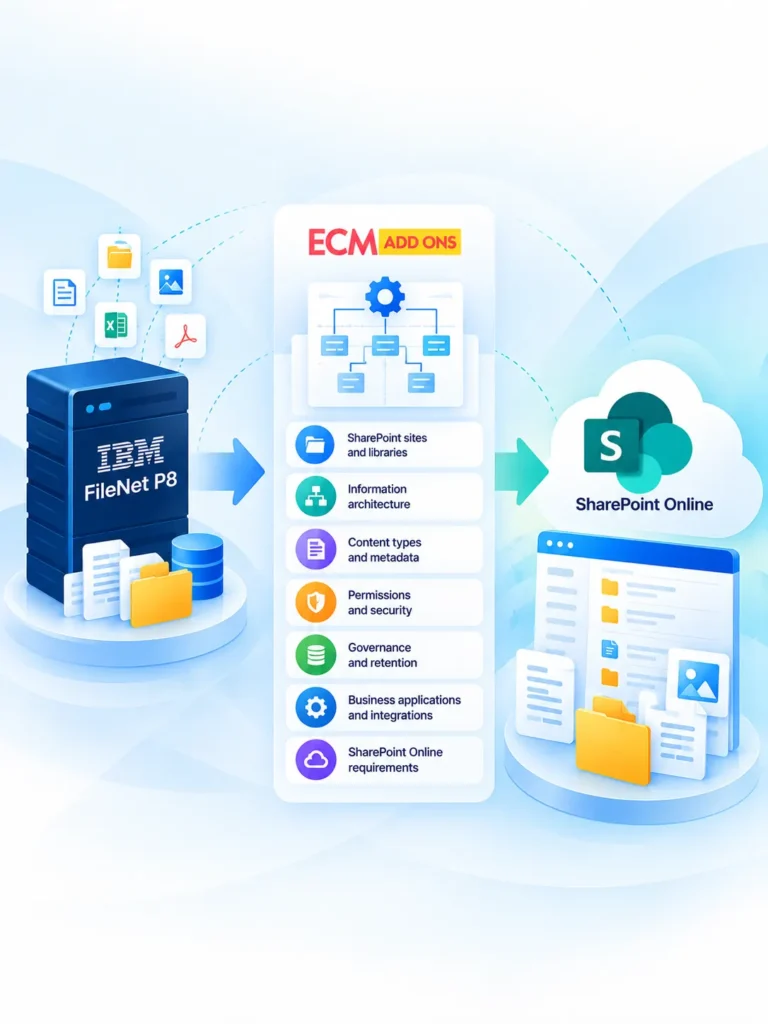
ECM Addons can help assess target requirements across:
- SharePoint sites and libraries
- Information architecture
- Content types and metadata
- Workflows
- Permissions and security
- Governance and retention
- Business applications and integrations
- SharePoint Online requirements
The objective is to preserve the business context of the content while allowing unnecessary legacy complexity to be reconsidered.
Designed for Complex FileNet P8 Environments
Different repositories and business units may have different structures, security requirements, and ownership models. Migration waves can be designed accordingly.
Existing classifications and properties may require mapping, rationalization, or transformation before they can fit the target information architecture.
Custom applications and workflows can influence migration sequencing, testing, and the way content is used after transition.
SAP processes, APIs, ERP, CRM, and other integrations can create dependencies beyond the FileNet repository itself.
FileNet Expertise Meets Migration Engineering
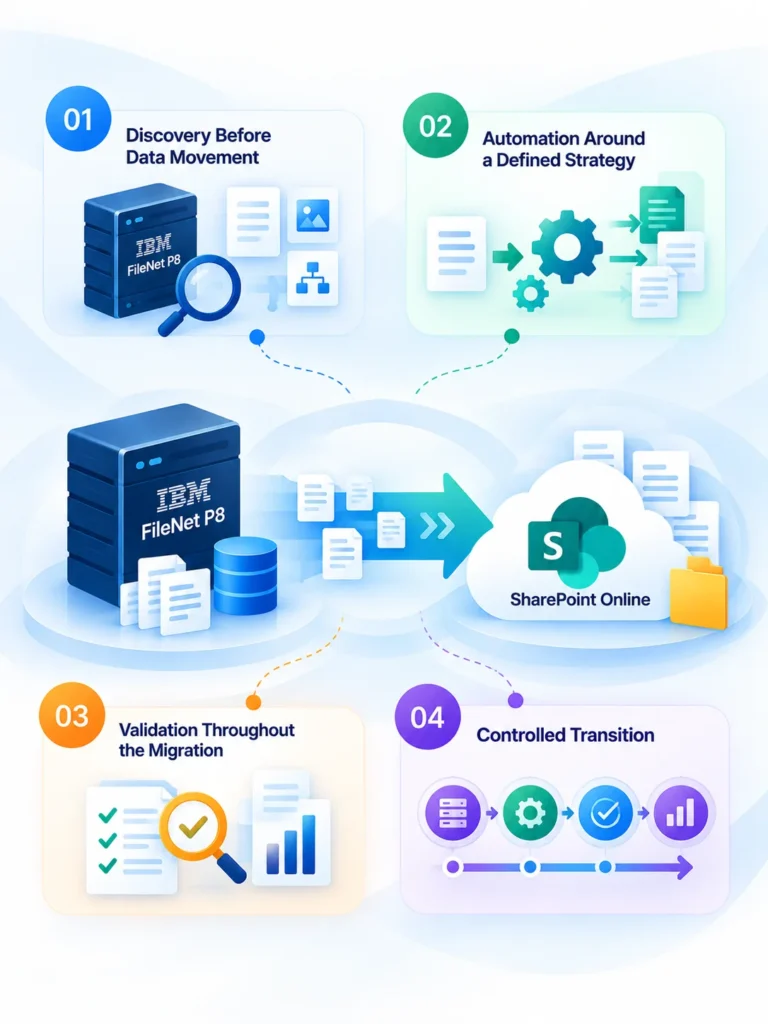
Discovery Before Data Movement
The migration starts with understanding the FileNet P8 environment – not with immediately moving content.
Automation Around a Defined Strategy
The FileNet P8 migration solution supports automation, but technology follows the migration strategy. What moves, how it transforms, and where it goes are defined first.
Validation Throughout the Migration
Validation and reconciliation are incorporated into the migration process rather than treated as a final document-count exercise.
Controlled Transition
Where FileNet P8 must remain operational during migration, the strategy can incorporate phased execution, synchronization, testing, validation, and controlled cutover.
Why Choose ECM Addons for FileNet P8 Migration?
ECM Addons combines deep IBM FileNet expertise with enterprise migration engineering to address complex FileNet P8 environments where content management is deeply embedded in business operations.
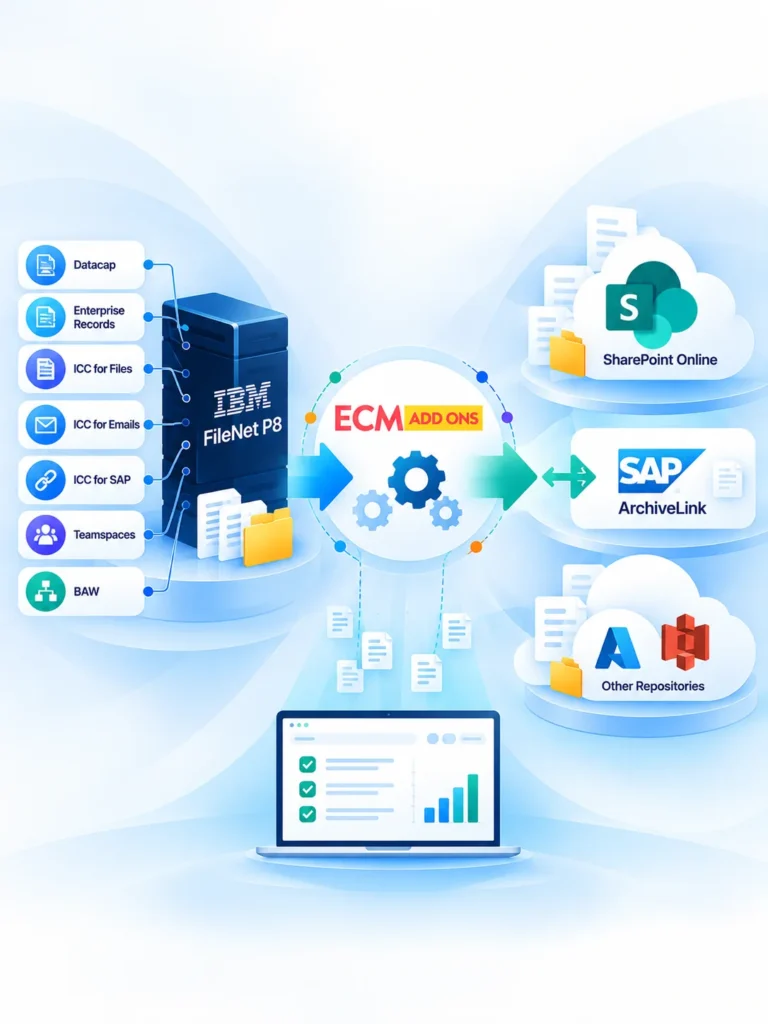
Our current migration project involves 400+ million documents in a highly complex FileNet environment that extensively uses multiple IBM FileNet components, including IBM Datacap, IBM Enterprise Records, IBM Content Collector (ICC) for Files, ICC for Emails, ICC for SAP, Teamspaces, and IBM Business Automation Workflow (BAW).
We assess repositories, object stores, document classes, metadata, security, workflows, applications, and integrations to identify dependencies and define a migration strategy tailored to the existing environment and target architecture.
Our FileNet P8 migration software supports automated extraction, transformation, migration, synchronization, monitoring, and validation, helping enterprises manage migration waves, track progress, and identify exceptions.
Beyond FileNet migration, ECM Addons also supports enterprise content modernization through SAP ArchiveLink integration with SharePoint Online and other content repositories, helping organizations modernize how SAP business documents are stored and accessed. Explore Content Synergy to learn more about our SAP ArchiveLink solutions.
By combining FileNet expertise, migration automation, and structured validation, ECM Addons helps enterprises plan and execute complex migrations while accounting for critical content, business context, and application dependencies.
Start Your FileNet P8 Migration Trial Today
Explore a controlled FileNet P8 migration with a free trial. Validate your migration approach, assess your content and dependencies, and see how ECM Addons can support your transition to your target platform.
Frequently Asked Questions
FileNet P8 Migration Services help enterprises assess and migrate content and associated information from IBM FileNet P8 to a target content platform. Depending on scope, this can include documents, metadata, classifications, security, versions, workflows, applications, integrations, and governance requirements.
A basic document migration focuses primarily on files. IBM FileNet P8 migration may also require the migration strategy to address document classes, metadata, permissions, workflows, applications, integrations, and business dependencies.
Yes. FileNet properties, classifications, and related metadata can be analyzed and mapped to the target environment. Depending on the target architecture, information may be mapped directly, transformed, reorganized, or incorporated into a different information model.
FileNet P8 security requirements can be assessed as part of the migration. The migration design determines how relevant access requirements should be represented within the target platform’s security model.
Applications and integrations are identified during discovery because they can affect migration scope, sequencing, testing, and cutover. Relevant SAP, ERP, CRM, API, and custom application dependencies can be incorporated into the migration strategy.