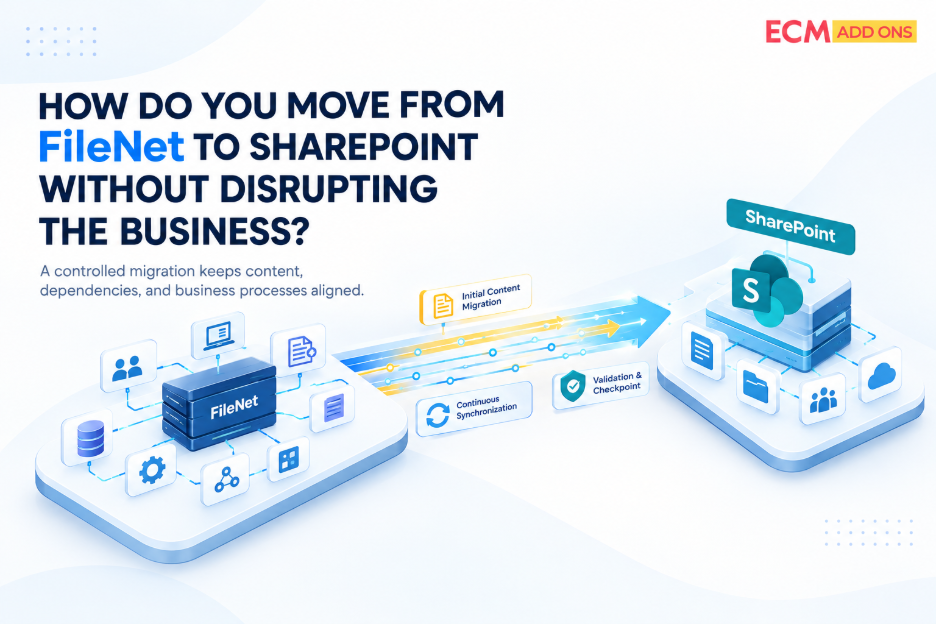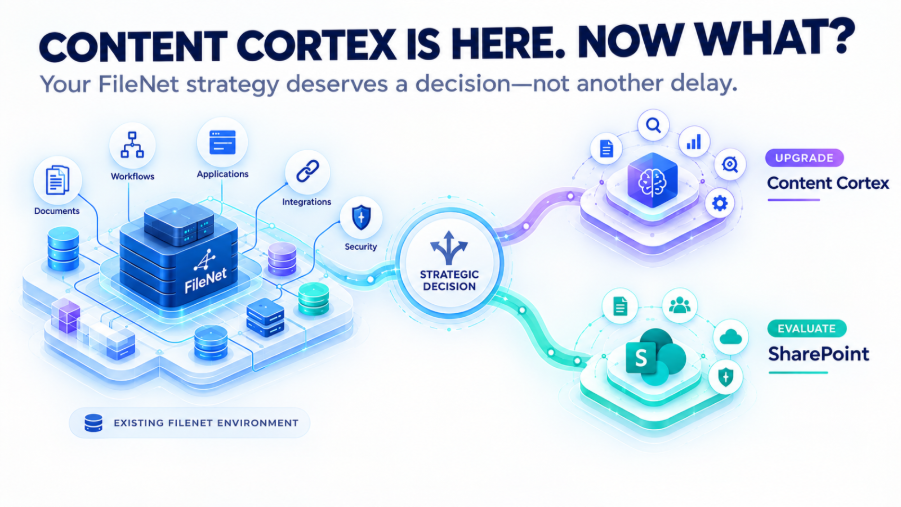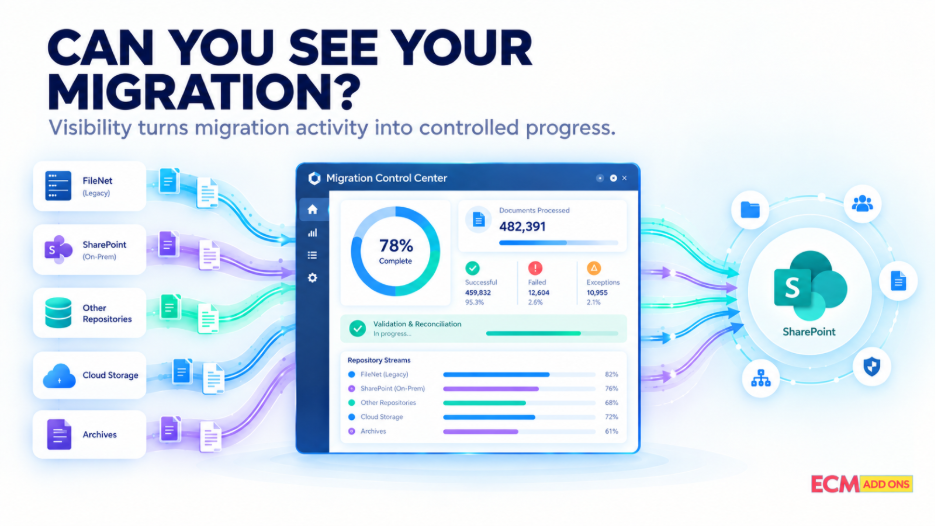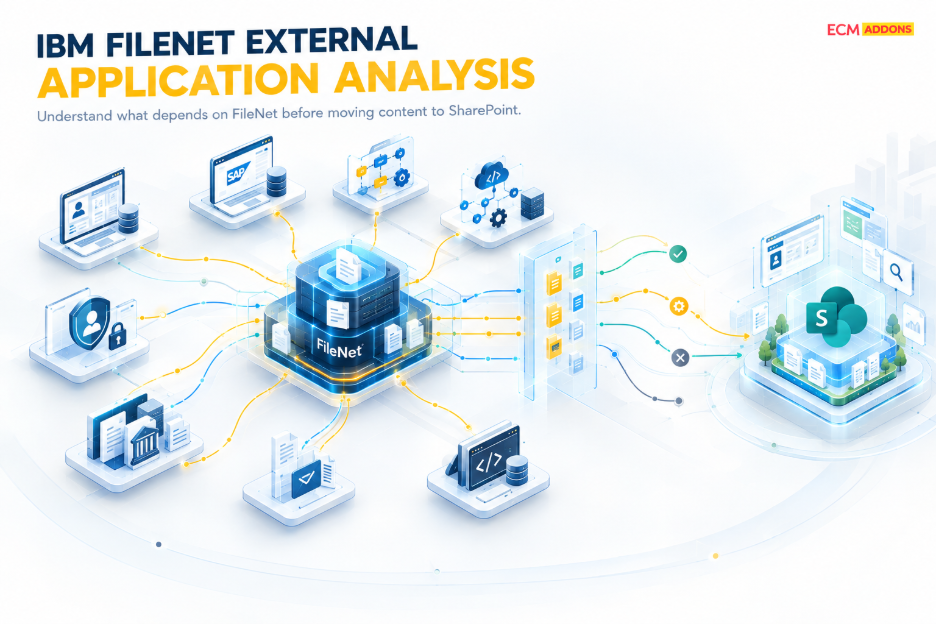
When organizations plan an IBM FileNet to SharePoint migration, application discovery cannot stop at identifying documents, object stores, metadata, document classes, workflows, records, and content volumes. Those elements establish what exists inside the FileNet environment, but they do not fully explain how the organization uses that content. Enterprise FileNet environments often sit underneath business applications, ERP and CRM platforms, SAP processes, workflow applications, custom applications, APIs, identity services, email-driven processes, and user-facing interfaces. These external dependencies can determine whether a migration continues to support the business after the repository changes.
FileNet external application analysis is the process of identifying and assessing the applications, systems, interfaces, APIs, services, and business processes outside the FileNet repository that depend on FileNet content or functionality.
The purpose is to understand what each application does with FileNet, which FileNet-specific capabilities it uses, what content and metadata it depends on, how security and identifiers are handled, and what must change when that dependency moves to a SharePoint-based target architecture.
This distinction is important because a FileNet migration can successfully move documents while leaving the applications that use those documents connected to the old environment. An application may still contain FileNet API calls, FileNet document identifiers, repository-specific URLs, document-class assumptions, metadata dependencies, authentication patterns, or workflow integrations. In that situation, the migration may appear successful from a content perspective while the business process remains dependent on FileNet.
That is why the migration question should not simply be, “How do we move the documents?” A more useful question is,
Which external applications and business processes depend on FileNet, what exactly do they depend on, and what must change when those dependencies move to SharePoint?
What Is FileNet External Application Analysis?
FileNet external application analysis is a structured assessment of the technology and business dependencies that exist outside the FileNet repository. It examines how applications and systems create, retrieve, search, update, process, display, link to, or govern content stored in FileNet.
For example, a CRM application may display customer documents that are stored in FileNet. An ERP process may generate an invoice and associate the resulting document with a transaction. A custom business application may retrieve documents through FileNet APIs, update metadata, or generate links to specific documents. An employee-facing portal may expose FileNet content through IBM Content Navigator or another integration layer. A workflow application may initiate or continue a process based on documents and metadata stored in FileNet.
Each of these represents a different dependency. The application name alone does not tell the migration team enough about what needs to change.
A useful external application analysis therefore looks at the actual interaction between the application and FileNet. It determines whether the application creates content, retrieves content, searches the repository, updates metadata, relies on particular document classes or object stores, uses FileNet identifiers, generates repository links, calls FileNet APIs, depends on FileNet security, or participates in a workflow that uses FileNet content.
The assessment should ultimately answer five fundamental questions. What does the application do with FileNet? Which FileNet-specific capability does it depend on? What content, metadata, identifiers, security model, or process information does it use? What must change when the dependency moves to the target environment? And how will the changed application and business process be validated before cutover?
Why Does External Application Analysis Matter Before a FileNet to SharePoint Migration?
The importance of application dependency analysis becomes clearer when considering a simple business scenario. Imagine a customer management application that displays a contract whenever an employee opens a customer record. The contract itself may be migrated successfully from FileNet to SharePoint. However, the customer application may still be configured to retrieve that contract using a FileNet API, a FileNet document identifier, a FileNet URL, a specific document class, or a FileNet authentication mechanism.
The document has therefore moved, but the application has not.
This is one of the reasons repository-level migration validation is not enough. The migration team needs to establish whether applications can continue to perform the business operations they were designed to support. A technically successful content migration does not automatically mean that applications can retrieve the correct content, update metadata, initiate workflows, follow document links, or maintain the required security model in the target environment.
The target platform introduces its own architecture and integration mechanisms. SharePoint provides its own APIs, authentication mechanisms, permissions, metadata structures, URLs, and application integration approaches. Consequently, a FileNet dependency normally needs to be assessed and mapped to an appropriate target-state approach rather than assumed to have a direct equivalent.
This analysis should take place before the target integration architecture, remediation strategy, testing approach, and cutover plan are finalized. Discovering a critical application dependency immediately before production cutover can affect sequencing, testing, remediation, and business continuity.
Which Applications Should Be Included in a FileNet Dependency Analysis?
The analysis should begin with business applications that directly create or consume FileNet content. However, the objective is not simply to create a list of application names. The migration team needs to understand the role each application plays in the content lifecycle.
An application that only retrieves documents has a different migration impact from an application that creates documents, updates metadata, performs repository searches, generates document links, starts workflows, and interacts with other enterprise systems. Similarly, an application that uses FileNet only for historical document retrieval may require a different target-state approach from an application that continuously creates new business content in the repository.
The assessment should therefore document how each application interacts with FileNet and why that interaction exists. It should capture the business function supported by the application, the type of content involved, the relevant metadata and identifiers, the interfaces being used, the security requirements, and the expected impact of moving the repository to SharePoint.
This distinction becomes particularly important for custom applications. Technical documentation for custom applications may be incomplete, outdated, or distributed across development teams and infrastructure teams. Repository inspection alone may not reveal every dependency. Application code, configuration, integration services, URLs, service accounts, logs, and interviews with application owners may all be necessary to establish how the application interacts with FileNet.
How Should ERP and CRM Dependencies Be Assessed?
ERP and CRM systems frequently provide the business context in which enterprise documents are created and consumed. The document may be stored in FileNet, but the business transaction that gives the document meaning may exist somewhere else.
For example, an ERP process may generate an invoice while FileNet stores the associated document. A CRM application may display contracts, correspondence, claims, customer documents, or other records alongside customer information. In both cases, migrating the documents without understanding the relationship between the business transaction and the FileNet content can create an incomplete target architecture.
The analysis should identify the business identifiers connecting the application to the content, the metadata exchanged between systems, the methods used to retrieve or search documents, the APIs or integration services involved, and the authentication and authorization requirements. It should also establish whether workflows or business rules depend on the relationship between the application and FileNet.
Once these dependencies are understood, the target architecture can determine whether the relationship should be remapped, integrated differently, redesigned, redeveloped, or retired. The objective should not be to reproduce every technical characteristic of the FileNet environment. The objective is to preserve the required business capability within the target architecture.
What Should Be Assessed in SAP and ArchiveLink-Connected FileNet Environments?
SAP-connected FileNet environments require particular attention because the relationship between SAP transactions and enterprise documents can extend beyond simple document storage.
The assessment should establish how SAP creates, references, retrieves, or manages documents whose content is stored in FileNet. It should identify the relevant document identifiers, metadata relationships, interfaces, authentication requirements, security considerations, and business processes that depend on those documents.
The key migration question is not simply whether SAP-related documents have been migrated. It is whether SAP can continue to work with those documents in the target architecture after FileNet is replaced or its role changes.
This distinction matters because an SAP process can remain operationally dependent on the source repository even after the content has been copied elsewhere. If the target architecture requires an SAP-to-SharePoint repository approach for a relevant ArchiveLink scenario, the integration design needs to address that relationship explicitly. ECM Addons provides SAP Content Bridge for SharePoint for relevant SAP ArchiveLink scenarios, but the appropriate approach should be determined from the actual SAP and FileNet architecture rather than assumed to be identical across environments.
Why Are FileNet APIs, Web Services, and Application Links Important?
Programmatic dependencies are among the easiest migration risks to miss because they may not be visible from the repository structure itself. An application can depend on FileNet through APIs, web services, REST interfaces, service endpoints, application credentials, repository searches, metadata operations, workflow calls, or generated document links.
For example, a custom application may contain logic that retrieves a FileNet object using a repository-specific identifier. Another application may generate links that open documents through FileNet or IBM Content Navigator. A background service may periodically search FileNet and update metadata based on another system’s activity.
These dependencies need to be identified before the source repository is decommissioned. Each interface should be examined in terms of what operation it performs, what information it requires, which application owns the dependency, and what target-state capability will replace or modify it.
The same principle applies to application URLs. If users, emails, portals, CRM screens, or business applications contain links to FileNet documents or IBM Content Navigator views, moving the underlying content does not automatically update those references. The migration plan must determine how those links will behave after cutover and whether they need to be regenerated, redirected, or replaced.
How Should Identity and Security Dependencies Be Analyzed?
Application dependency analysis should also examine how users, applications, and services authenticate and authorize access to FileNet content.
This includes directory services, user and group mappings, service accounts, application identities, single sign-on mechanisms, roles, authorization rules, and permission dependencies. A custom application may not simply ask whether a document exists. It may retrieve content only when a user or service identity has the appropriate permissions.
The target SharePoint architecture has its own identity and permission model. Consequently, the migration team should determine how the business access requirement maps to the target security model instead of assuming that FileNet permissions can be copied unchanged.
This is particularly important when application access and user access are different. A service account used by a business application may require a different target configuration from an employee accessing the same content through SharePoint. Understanding these distinctions before migration allows security design and application remediation to be tested together rather than treated as separate activities.
What About External Repositories and Referenced Content?
Another important question during external application analysis is whether the content is actually stored in FileNet or whether FileNet is referencing content managed somewhere else.
Enterprise applications can interact with external repositories, federated content, referenced documents, or content owned by another system. The FileNet repository may provide metadata or access mechanisms while the physical content remains under another system’s control.
This distinction can materially change migration scope. The assessment should establish ownership of the content, metadata relationships, synchronization mechanisms, access requirements, retention dependencies, and the role FileNet plays in providing access to the content.
Without this analysis, a migration team may assume that every document associated with FileNet is part of the same physical migration scope. In reality, some content may require a different migration strategy or may remain in its existing system while only the associated metadata or reference relationship changes.
Why Should FileNet Dependencies Be Mapped to Business Processes?
One of the most useful improvements to application analysis is to move beyond isolated technical connections and follow the information through the actual business process.
Consider a customer-facing process in which a customer record triggers document creation, the document is stored in FileNet, metadata is added, an approval takes place, the CRM application later retrieves the document, and the resulting record is eventually subject to retention requirements. Each stage represents a potential dependency.
The value of mapping the complete process is that it reveals relationships that may not be visible when applications are assessed independently. A CRM team may know that it retrieves documents from FileNet. The workflow team may know that the same documents participate in approvals. The records team may know that the documents have retention requirements. The migration team needs to understand all three relationships because changing the repository can affect the complete process.
This produces a dependency map rather than a simple application inventory. More importantly, it provides the information required to determine which dependencies need remediation before migration and which can be addressed after migration.
How Should FileNet Dependencies Influence Migration Decisions?
Once a dependency has been identified, it should be evaluated against the business requirement and the target SharePoint architecture.
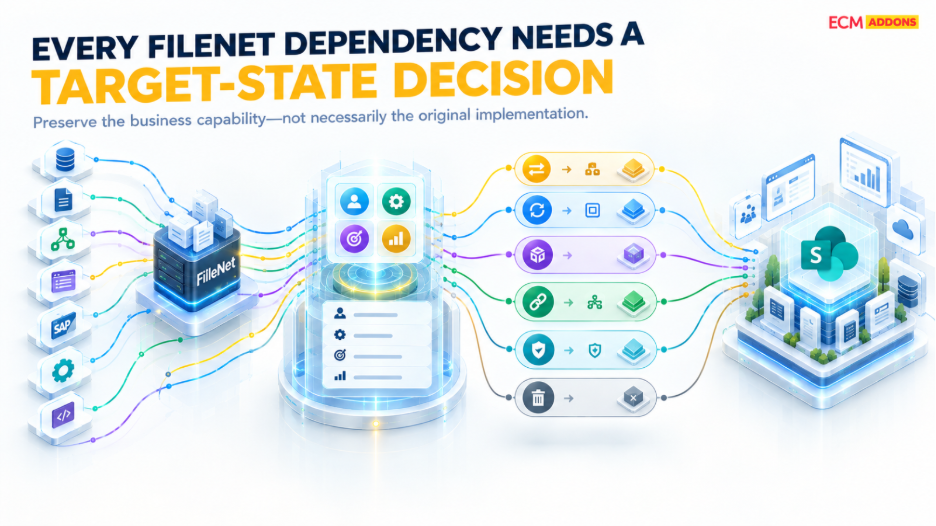
Some dependencies may only require a mapping or configuration change. Metadata may need to be transformed, application links may need to be updated, or an existing integration may need to point to a new endpoint. Other dependencies may require more substantial application redevelopment because the application relies on a FileNet-specific capability that does not exist in the same form in the target environment.
Workflows may need to be redesigned. Custom applications may need to be rebuilt or replaced. An obsolete application may no longer be required and can be retired. An external repository may need to remain integrated rather than being migrated into SharePoint.
The important principle is that the target architecture should be designed around the business requirement rather than around the assumption that FileNet must be recreated inside SharePoint.
This prevents migration projects from turning into simple technology replication exercises. The purpose of dependency analysis is to provide enough information to make deliberate decisions about what should be retained, remapped, integrated, redesigned, replaced, or retired.
What Should Be Validated Before FileNet Migration Cutover?
Validation should extend beyond confirming that documents have arrived in SharePoint.
For business-critical applications, the migration team should validate whether users and systems can perform the business operations that depend on the migrated content. This can include retrieving documents from applications, searching content, updating metadata, following application links, enforcing permissions, initiating workflows, completing SAP or ERP transactions, accessing documents through CRM systems, executing API calls, creating new content, handling errors, and maintaining records or retention processes.
This distinction between technical migration validation and business-process validation is critical. A migration operation may report that content has been successfully transferred while an application dependency remains unresolved. The migration job can therefore complete successfully while the business process still fails.
For this reason, application testing should be connected directly to the dependency analysis performed during discovery. If the analysis identified a CRM dependency, CRM retrieval should be part of validation. If it identified an SAP dependency, the relevant SAP transaction should be tested. If a custom application uses FileNet APIs, the corresponding target integration should be tested before production cutover.
What Is the Difference Between Internal FileNet Analysis and External Application Analysis?
Internal FileNet analysis and external application analysis answer different questions, and both are required for a complete migration assessment.
Internal analysis establishes what exists within the FileNet environment. This can include object stores, document classes, records, configurations, Content Navigator components, and other repository-level structures. External application analysis establishes what exists outside FileNet that depends on those capabilities, including ERP systems, CRM applications, SAP processes, custom applications, APIs, identity services, email processes, and other integrations.
The distinction can be summarized simply: internal analysis tells the migration team what exists, while external analysis explains what depends on it.
Neither perspective is sufficient on its own. Understanding the FileNet repository without understanding its consuming applications leaves the business impact unclear. Understanding external applications without understanding the FileNet structures they consume makes it difficult to design the target architecture correctly.
Together, these assessments create a more complete picture of the source environment and provide the foundation for defining the target-state architecture.
How Does Dependency Analysis Affect Migration Planning and Cutover?
Once application dependencies have been analyzed, they should directly influence migration sequencing.
A dependency that supports a business-critical process may require application remediation and integration testing before the associated content is moved. Another application may be suitable for a later migration wave because it only accesses historical content. A third application may need to be redesigned before migration because its current functionality is tightly coupled to FileNet.
The migration plan should therefore connect the existing FileNet dependency to the business requirement, the target SharePoint capability, the required integration change, the testing approach, and the cutover strategy.
Cutover should also account for dependencies that continue to generate or consume content. For example, if SAP is still sending documents to FileNet, a CRM system is still retrieving documents from FileNet, or a custom application is still making FileNet API calls, the migration team needs a defined transition strategy before the source environment can be decommissioned.
This is why dependency analysis should not be treated as a discovery activity that ends once the inventory is complete. It should remain connected to remediation, migration waves, testing, reconciliation, and production cutover
Final Thoughts
An IBM FileNet to SharePoint migration is not simply a repository migration. It can change how enterprise applications create, retrieve, search, update, process, share, and govern content.
That is why IBM FileNet external application analysis belongs in the discovery and planning stage of a migration. The objective is to understand the relationship between FileNet content and the applications and business processes that depend on it before the source repository is changed.
The central question is therefore not simply whether the documents have moved successfully. The more important question is whether the applications, integrations, workflows, users, and business processes that depend on those documents can continue to operate correctly in the target environment.
A complete assessment connects content with its metadata, security, applications, workflows, integrations, business processes, validation requirements, and cutover dependencies. Once those relationships are understood, the migration team can make more informed decisions about what should be migrated, remapped, integrated, redesigned, replaced, or retired.
That is ultimately the purpose of FileNet external application analysis: to understand what depends on FileNet before changing the platform that those dependencies rely on.
Planning an IBM FileNet to SharePoint Migration?
Before moving content, assess the applications, integrations, APIs, workflows, security dependencies, and business processes connected to your FileNet environment.
ECM Addons can help assess FileNet application dependencies and incorporate those findings into a structured FileNet to SharePoint migration strategy.
Explore the FileNet to SharePoint Migration Tool or discuss your migration requirements with ECM Addons.