Your FileNet version may tell you that it is time to act. Your business requirements should tell you what to do next.
For organizations that have relied on IBM FileNet for years, the question is no longer simply whether the platform continues to support the business.
The more important question is:
What should the future of your enterprise content environment look like?
For some organizations, the answer may be an evolution toward IBM Content Cortex.
For others, the right path may be to modernize the existing FileNet environment.
And for organizations looking to align content management more closely with the Microsoft ecosystem, a FileNet to SharePoint migration may make more sense.
The challenge is that there is no universal answer.
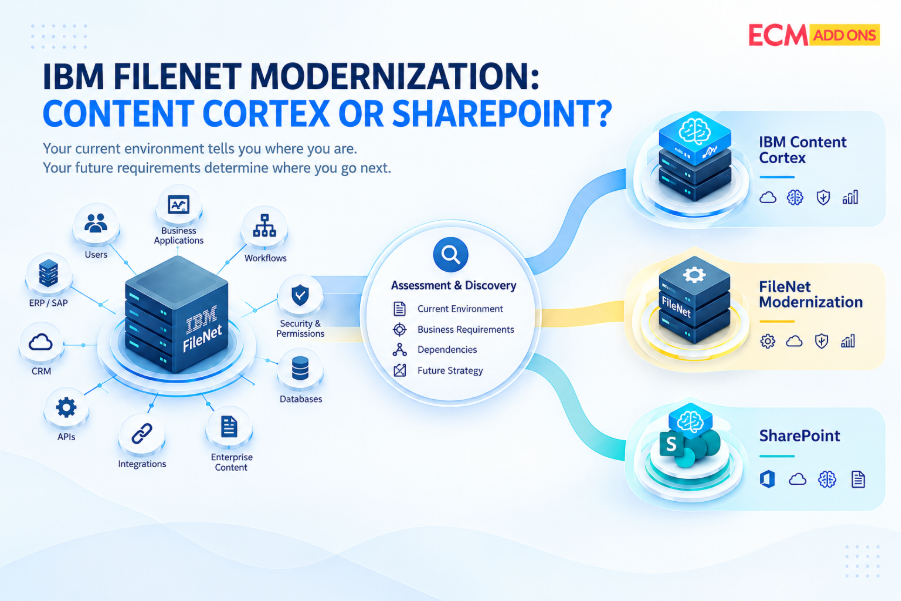
Before deciding, organizations need to understand where their FileNet environment stands today, what business problems it needs to solve, what applications and integrations depend on it, and where the organization wants to go next.
That decision should begin with discovery-not assumptions.
Start With Where Your FileNet Environment Is Today
This matters because your version determines your current support position, upgrade considerations, technical constraints, and the urgency of your decision.
IBM’s current lifecycle information shows that FileNet Content Manager 5.5.x reaches its listed End of Support date on September 30, 2026. IBM lists 5.6.0 and 5.7.0 on newer support cycles, while IBM Content Cortex 26.0.0 was released in June 2026.
But the version number alone should not determine the future-state decision.
Two organizations running the same FileNet release can have completely different requirements.
One may have heavily customized FileNet applications, workflows, integrations, and business processes that make modernization or an IBM-aligned evolution more practical.
Another may already have a strong Microsoft 365 and SharePoint strategy and may see the migration as an opportunity to consolidate its content platform.
Another may have a relatively stable FileNet environment where an upgrade or modernization approach makes more sense than a full repository migration.
The version tells you where you are.
The business and technical assessment tells you where you should go.
The First Step Is Understanding the Existing Environment
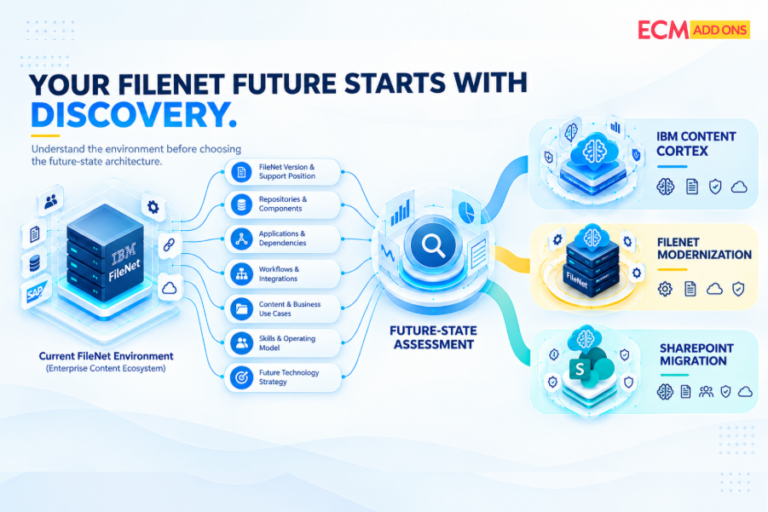
Before deciding between Content Cortex, FileNet modernization, or SharePoint migration, organizations need a detailed view of their current environment.
That means looking beyond document volume.
You need to understand:
- Which FileNet version and components are currently deployed?
- Which repositories and Object Stores are in use?
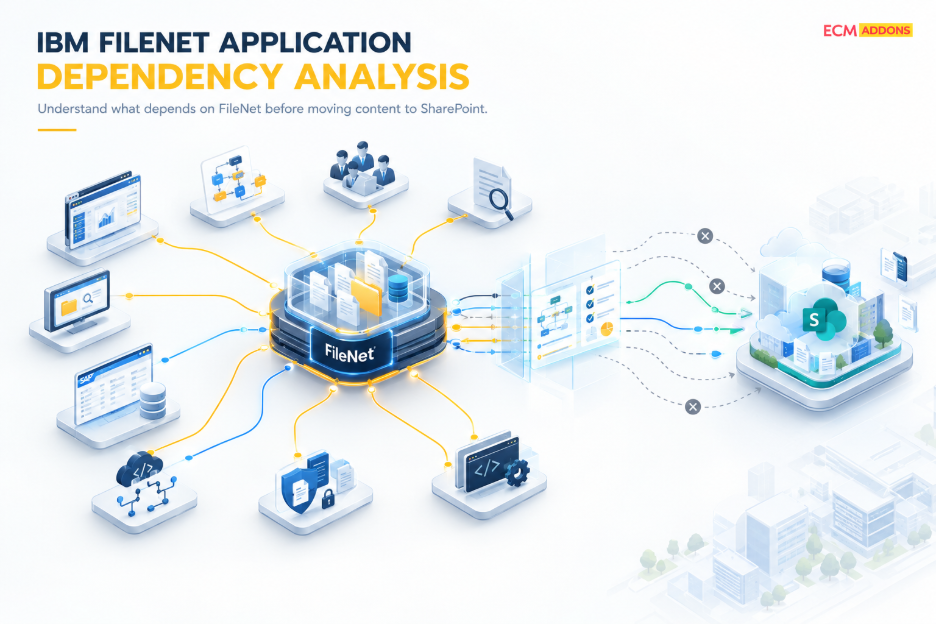
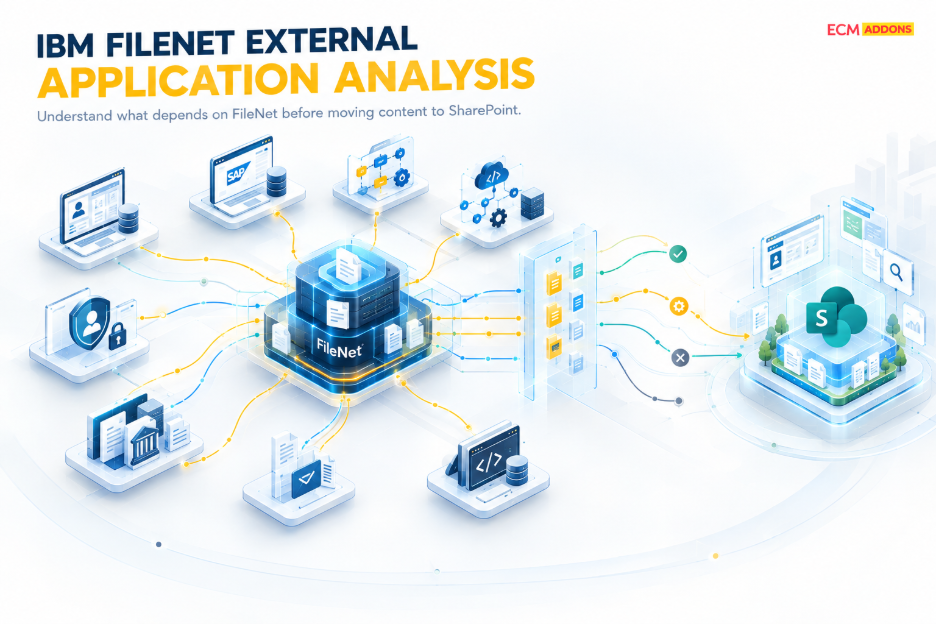
- Which applications depend on FileNet?
- Which business automation workflows are running on or around the platform?
- Which integrations connect FileNet to other enterprise systems?
- How is Content Navigator being used?
- Are there customizations or extensions?
- How are users accessing and working with content?
- Which business processes depend on FileNet?
- What content is active, historical, regulated, or no longer required?
- How much of the environment is still strategically important?
- What does the organization want its future content architecture to look like?
This is where discovery becomes the foundation of the decision.
You cannot confidently determine the destination until you understand the environment you are starting from.
Start by understanding what is actually running in your FileNet environment.
Then Ask: What Is the Business Actually Trying to Achieve?
Technology should follow the business requirement.
Consider three different situations.
Scenario 1: FileNet remains strategically important
If FileNet continues to support critical business processes, applications, workflows, and content requirements, the organization may not want to abandon the investment it has already made.
The question then becomes:
How should the existing environment evolve?
This is where an upgrade or modernization strategy may need to be evaluated, including the move toward IBM Content Cortex where it aligns with the organization’s requirements and future-state direction.
Scenario 2: The organization wants to evolve its IBM content platform
For organizations that want to continue with IBM’s content platform direction while moving toward newer capabilities, IBM Content Cortex becomes an important option to evaluate.
Content Cortex represents IBM’s current direction for content management and builds on the FileNet foundation rather than treating enterprise content as something that necessarily needs to be abandoned.
IBM’s current support information identifies IBM Content Cortex 26.0.0 as a current release, with End of Fix and End of Usage dates still to be determined.
But moving toward Content Cortex should not be treated as simply:
“Our FileNet version is old → upgrade → done.”
The organization still needs to understand its current components, customizations, applications, integrations, workflows, content structures, and business use cases.
The transition needs to be planned around the actual environment and the desired future state.
Scenario 3: The organization wants to move toward SharePoint
Some organizations may already have a broader Microsoft strategy built around SharePoint, Microsoft 365, Azure, and related services.
In that situation, continuing to invest heavily in the existing FileNet architecture may not align with the organization’s long-term technology direction.
The question becomes:
Can the organization’s FileNet content, business processes, integrations, and required capabilities be transitioned effectively into a SharePoint-based environment?
That requires much more than transferring documents.
It requires understanding what applications and processes depend on FileNet, which components need equivalent capabilities, which integrations need to be changed, and what should happen to functionality that does not have a direct SharePoint equivalent.
For organizations evaluating SharePoint as the future-state platform, this assessment needs to extend beyond content migration to applications, components, integrations, workflows, and business dependencies.
Beyond FileNet: Defining the Future Content Ecosystem
Your modernization path should align not only with today’s content requirements, but with the platform and AI ecosystem you intend to build around tomorrow.
At a strategic level, the future-state decision is also about which enterprise content ecosystem the organization wants to build around AI and emerging content capabilities.
If the organization intends to continue within the IBM content ecosystem, the path forward can be evaluated around IBM Content Cortex and its AI-enabled content capabilities, while assessing how the existing FileNet environment, applications, integrations, workflows, and business processes transition into the new architecture.
If the organization is moving toward the Microsoft ecosystem, a FileNet to SharePoint migration can provide the foundation for a future content environment aligned with SharePoint, Microsoft 365, and the broader Microsoft AI ecosystem.
The strategic question, therefore, is not simply where today’s FileNet content should reside. It is also which technology ecosystem the organization wants to build its future enterprise content and AI capabilities around.
Exploring IBM Content Cortex for Your FileNet Environment?
If you are evaluating the next stage of your IBM FileNet environment, our team can help you assess IBM Content Cortex, your existing content architecture, integrations, security and governance requirements, and the potential path toward an AI-enabled content environment.
Talk to our FileNet and enterprise content experts to explore what a Content Cortex–aligned future could look like for your organization.
IBM Content Cortex vs. FileNet Modernization vs. SharePoint Migration
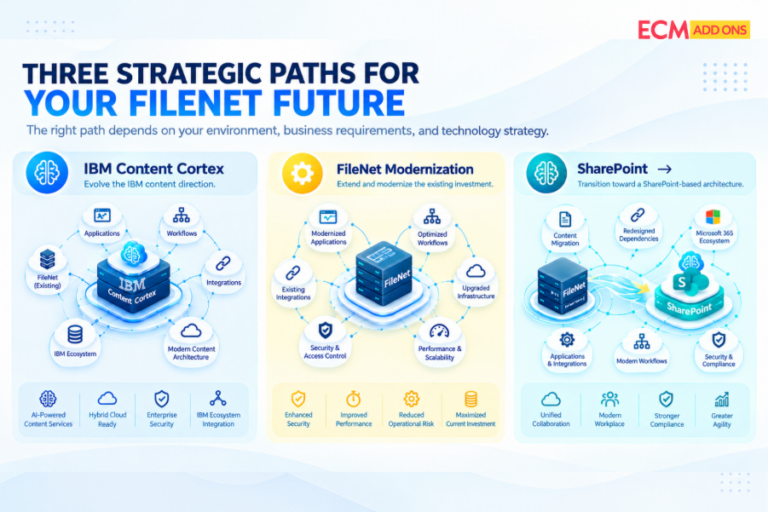
These paths should not be selected simply because one platform is newer or because another platform is already present in the organization. The decision should be based on the existing environment, business requirements, technical dependencies, and future-state objectives.
IBM Content Cortex
For organizations looking to continue evolving within the IBM content ecosystem, IBM Content Cortex can provide a path forward. The existing FileNet environment, business processes, components, integrations, applications, and content should be assessed to determine what needs to transition and how it aligns with the future architecture.
- Future-state objective: Evolve toward IBM’s newer content direction.
- Content migration: May be part of the transition.
FileNet Modernization
For organizations that want to extend their existing FileNet investment, modernization can focus on improving the current environment while preserving and enhancing business capabilities. Existing components and integrations can be maintained or upgraded where appropriate, with application changes generally focused on modernization.
- Future-state objective: Extend the FileNet investment.
- Content migration: May be limited depending on the approach.
FileNet → SharePoint
For organizations moving toward a Microsoft-centric content environment, FileNet-to-SharePoint migration involves more than moving content. Business processes, FileNet components, applications, and integrations may need to be reassessed, redesigned, reimplemented, or replaced as part of the transition.
- Future-state objective: Move toward a SharePoint-based content environment.
- Content migration: Core part of the program.
The table is not a recommendation. It is a starting point for the assessment.
The important question is not:
Which platform is better?
It is:
Which future-state architecture best fits our business, applications, integrations, content, skills, and technology strategy?
Your Use Cases Matter More Than Your Platform Name
This is where many technology decisions become too simplistic.
Instead of starting with:
Should we move to IBM Content Cortex?
or:
Should we migrate to SharePoint?
start with:
What does FileNet actually do for the business today?
Is it primarily being used for:
- Enterprise document management?
- Case management?
- Records?
- Content-intensive business applications?
- Document-centric workflows?
- SAP-related content?
- Customer or policy documentation?
- Claims?
- Lending?
- Government records?
- Engineering or technical documents?
- High-volume archival content?
- Custom business applications?
The answer changes the migration or modernization strategy.
A repository supporting a few straightforward document-management use cases is very different from a FileNet environment embedded deeply into business applications and workflows.
The Integration Question Cannot Be Ignored
One of the most important questions is:
What else depends on FileNet?
FileNet environments rarely exist in isolation.
Applications may create and retrieve content.
Workflows may depend on FileNet.
Enterprise systems may exchange information with the repository.
Custom APIs may interact with FileNet.
SAP environments may rely on ArchiveLink.
Business applications may have been designed around FileNet capabilities.
This means a decision to move away from FileNet can also become an application and integration transformation project.
Similarly, moving toward a newer IBM content platform does not eliminate the need to understand the existing architecture.
Before deciding, organizations should map:
Applications → FileNet Components → Integrations → Workflows → Content → Business Processes
Only then can they determine what needs to be retained, modernized, redesigned, integrated, replaced, or migrated.
Don't Let End of Support Become the Entire Strategy
End of Support creates urgency.
But urgency should not replace strategy.
For example, organizations running FileNet Content Manager 5.5.x need to address the September 30, 2026 lifecycle milestone.
That does not automatically mean:
Migrate to SharePoint.
Nor does it automatically mean:
Move to Content Cortex.
Nor does it automatically mean:
Upgrade FileNet and continue as before.
It means:
It is time to understand the environment and make a deliberate future-state decision.
The version and support position establish the when.
The discovery establishes what.
The business strategy establishes the were.
A Better Way to Make the Decision
Before choosing the path, evaluate the environment across several dimensions.
- Current FileNet Position
Version, components, repositories, architecture, customizations, and support status.
- Business Use Cases
What processes depend on FileNet and how critical are they?
- Application Dependencies
Which applications create, retrieve, update, search, or otherwise interact with FileNet?
- Integration Landscape
Which systems are connected to FileNet, and how would those integrations operate in the future state?
- Content Landscape
What content needs to remain active, what can be retired, and what needs to be migrated or retained elsewhere?
- Future Technology Strategy
Is the organization moving toward an IBM content platform, a Microsoft-centric environment, or another enterprise architecture?
- Skills and Operating Model
What technology skills, support capabilities, and operational model does the organization want to maintain?
- Business Risk
Which approach provides the required level of continuity, validation, security, integration, and operational control?
- Investment Horizon
Is the organization looking to extend the existing investment, evolve it, or fundamentally change the content platform?
Only after answering these questions does the decision become clearer.
So, Where Should You Go?
There are three broad directions an organization may need to evaluate.
Upgrade to IBM Content Cortex
This may be worth evaluating when the organization wants to continue its IBM content management journey and evolve toward the newer Content Cortex direction.
The key question is:
Can our current FileNet environment and business requirements be transitioned effectively into the Content Cortex architecture we want for the future?
Modernize the Existing FileNet Environment
This may be relevant when FileNet remains deeply embedded in business operations and the organization wants to continue leveraging that investment while addressing version, infrastructure, performance, integration, or operational requirements.
The question becomes:
What needs to change in our existing FileNet environment to support the next stage of our business?
Migrate from FileNet to SharePoint Online
This may be appropriate when SharePoint and the broader Microsoft ecosystem are central to the organization’s future-state architecture.
But the question should not simply be:
“Can we move the documents?”
It should be:
“Can we transition the content, applications, components, integrations, workflows, and business processes that depend on FileNet into the target architecture?”
That distinction is critical.
The Decision Should Begin With Discovery
This is why a detailed FileNet assessment is so important.
Before recommending Content Cortex, modernization, or SharePoint migration, organizations need to understand:
What do we have?
What depends on it?
What is still required?
What needs to change?
What should the future architecture look like?
What is the most practical transition path for our specific environment?
There is no value in choosing a destination before understanding the starting point.
Where Does Your FileNet Strategy Go From Here?
If your organization is approaching an IBM FileNet support milestone, this is the right time to step back and evaluate the bigger picture.
Don’t start with:
“What should we upgrade to?”
Start with:
“What do we need our content environment to do over the next 5–10 years?”
Then assess whether that future is best supported by:
IBM Content Cortex
FileNet Modernization
FileNet → SharePoint Migration
The answer will depend on your FileNet version, business use cases, applications, integrations, components, content landscape, technology strategy, and long-term operating model.
The important thing is to make that decision before the support deadline, before application dependencies become migration blockers, and before a technical upgrade becomes an emergency project.
How ECM Addons Can Help
ECM Addons brings experience across IBM FileNet environments, IBM Content Cortex, enterprise content migration, FileNet components, applications, integrations, and SharePoint migration.
Our approach starts with understanding the existing environment rather than assuming the destination.
We can help organizations:
Assess the current FileNet environment and support position.
Discover applications, components, workflows, integrations, repositories, and dependencies.
Evaluate business use cases and future-state requirements.
Determine whether Content Cortex, FileNet modernization, or SharePoint migration aligns with the organization’s needs.
Plan the appropriate transition strategy.
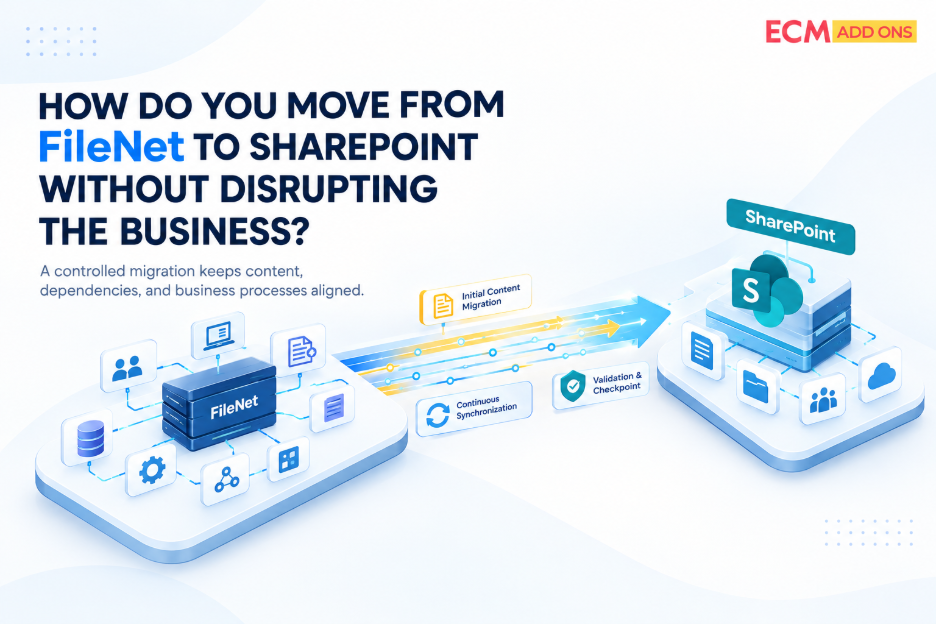
Execute the selected path with a focus on continuity, integration, validation, and controlled transition.
The objective is not to push every organization toward the same destination.
It is to help you understand your current environment well enough to make the right future-state decision for your business.
The Question for Every FileNet Organization
Your FileNet environment has already been supporting your business for years.
The question now is not simply whether you need to upgrade.
It is:
Where do you want your enterprise content environment to go next?
Ready to Evaluate Your FileNet Future?
If your IBM FileNet environment is approaching a support milestone, don’t wait until the deadline determines your next move.
Start with a clear understanding of your current environment, dependencies, business use cases, and future-state requirements. From there, you can evaluate whether IBM Content Cortex, FileNet modernization, or FileNet → SharePoint migration is the right direction for your organization.
Start with a FileNet environment assessment and identify the practical path forward.
What direction is your organization heading toward?